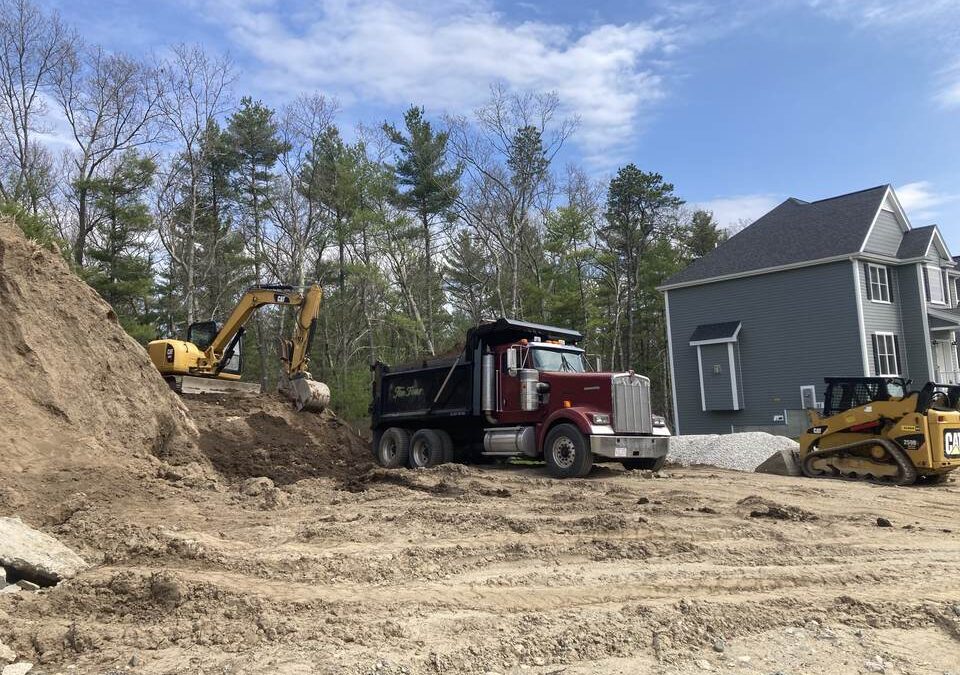
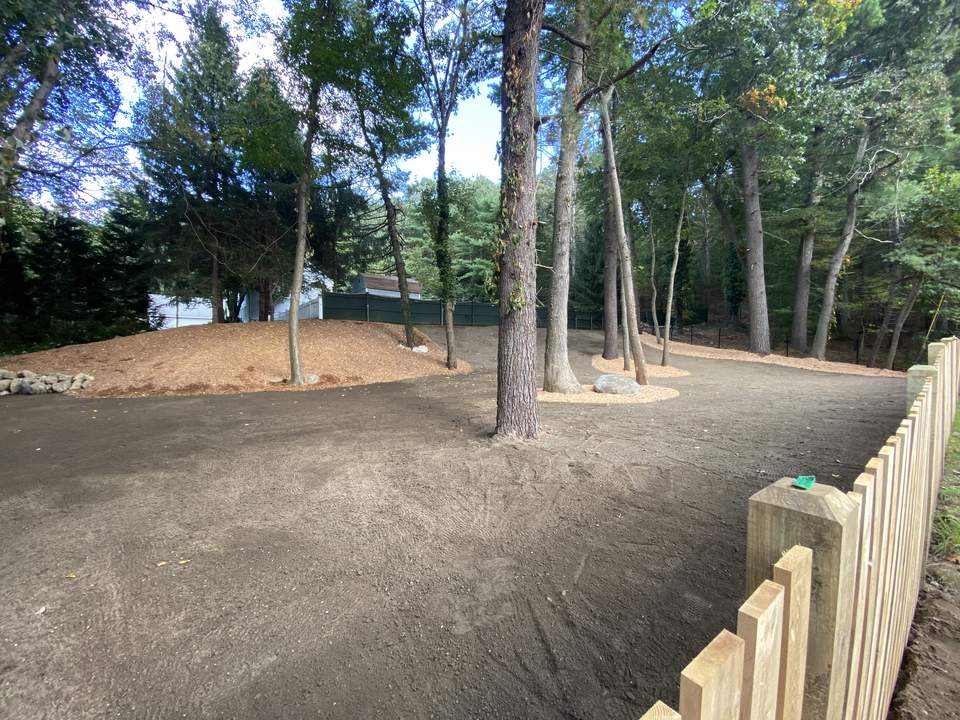
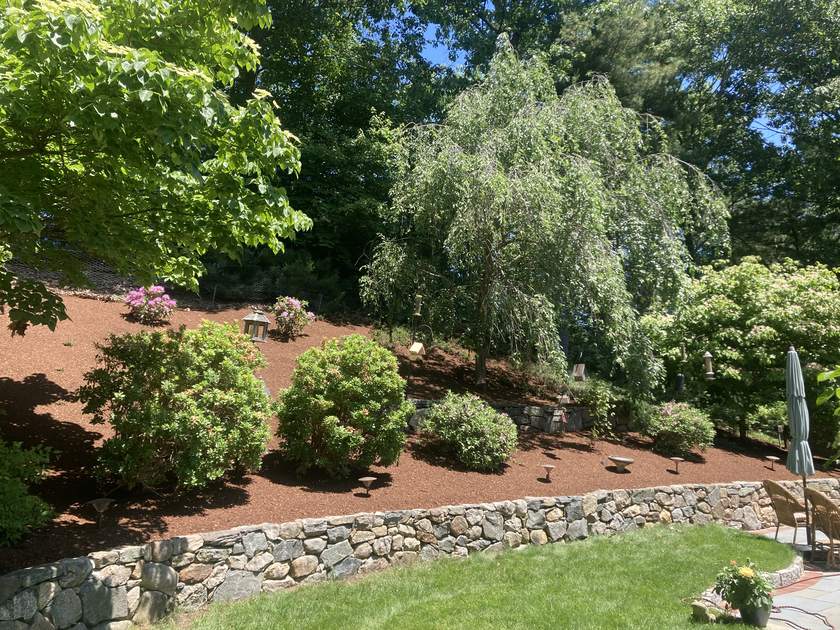
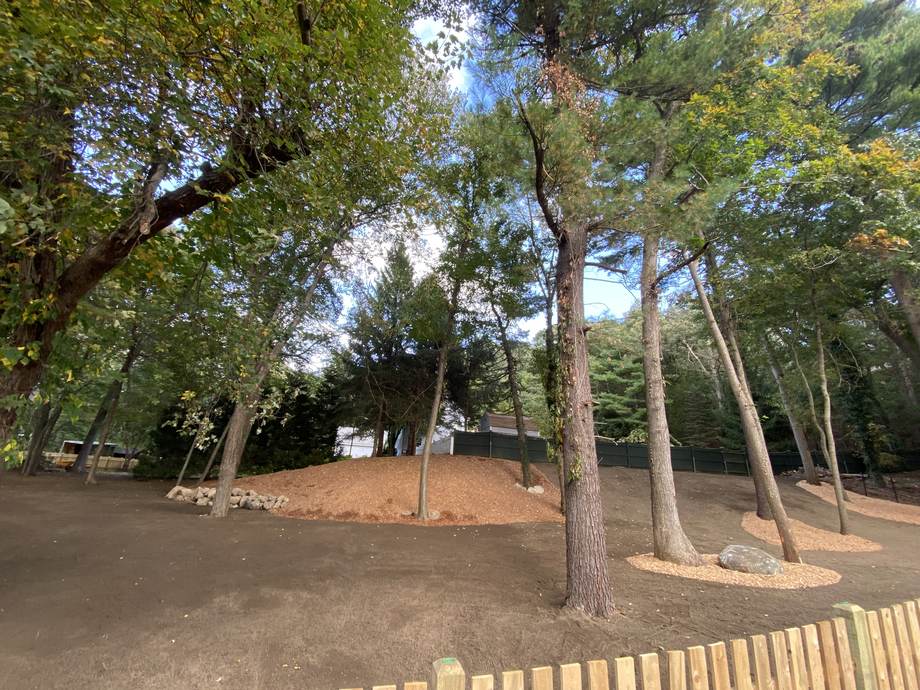
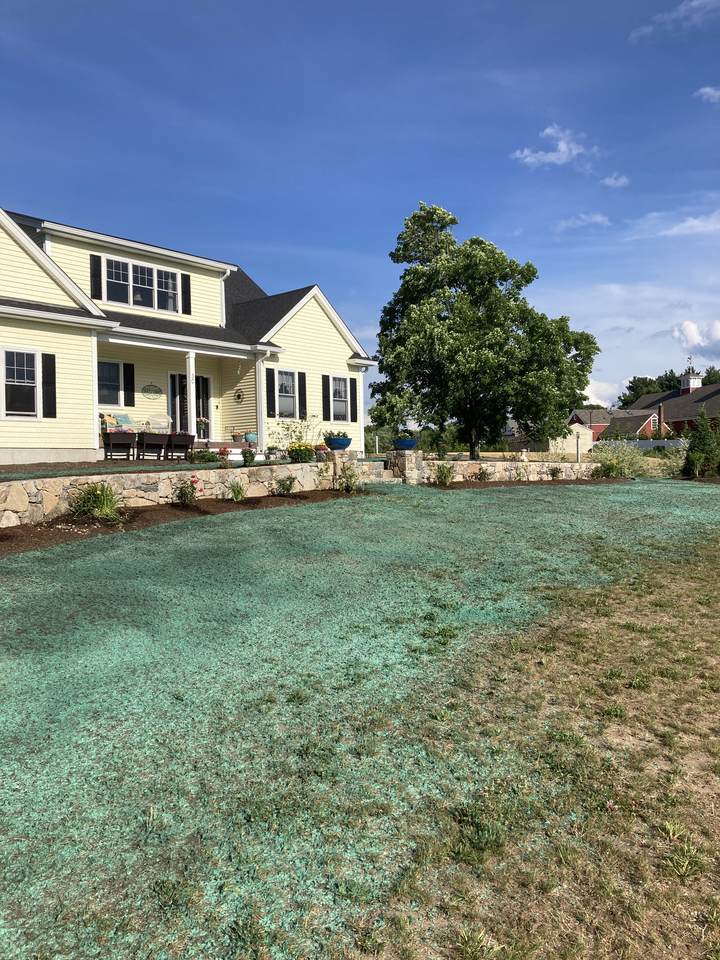
Your yard floods because water arrives faster than the soil can absorb it and has nowhere else to go. In Wrentham and the rest of Norfolk County, the usual culprits are poor grading, dense clay soil, downspouts dumping at the foundation, and a high water table. To fix yard drainage, you first find where the water comes from, then give it a clear path away from the house using regrading, French drains, dry wells, or a combination.
Why yards flood in Norfolk County
Most of Wrentham, Norfolk, and Franklin sits on glacial till, a dense mix of clay, silt, and rock. Water moves through it slowly, so a heavy spring rain or a March snowmelt sits on top instead of soaking in. In addition, many neighborhoods were built on low fields where the water table sits just a few feet down.
The second factor is grading. Builders are supposed to slope the ground away from the house. However, foundation backfill settles over five to ten years, and the yard ends up tilting back toward the basement. Add a patio, a shed, or a neighbor’s new driveway, and the flow changes again.
The five most common causes
Poor grading: the yard slopes toward the house or has a low bowl with no outlet.
Clay soil: water cannot percolate, so it pools on the surface.
Downspouts: gutters drop hundreds of gallons at the foundation during a single storm.
Compacted lawn: years of mowing and foot traffic seal the top two inches.
High water table: groundwater rises to the surface in spring and after big storms.
Most flooded yards have two or three of these at once. For example, a Foxboro lawn on clay with two downspouts pointed at a low corner is a classic case. Because the causes stack, the plan to fix yard drainage usually stacks too.
How to diagnose your yard drainage problem
Before you spend money to fix yard drainage, watch the water. Go outside during a steady rain and note where it flows, where it pools, and how long it takes to drain. Then check again 24 hours later. Puddles that vanish in a day point to compaction or grading. Puddles that last three or more days point to clay or a high water table.
A simple percolation test
Dig a hole 12 inches wide and deep in the wet area. Fill it with water, let it drain, and fill it again. Time how fast the second fill drops. Healthy loam drains an inch an hour or faster. Clay in Norfolk County often drains less than a quarter inch an hour. That number tells you whether a dry well will work or whether you must move water elsewhere.
Check the house first
Walk the foundation. The ground should drop at least six inches over the first ten feet. Note where every downspout ends. Next, look for stains or efflorescence on basement walls, which show where water is pushing in. Finally, note any spot where a neighbor’s yard, the street, or a driveway sends water onto your lot.
Solutions to fix yard drainage, from simple to major
Start with the cheapest fix that addresses the biggest cause. Often that is the downspouts. Then work up to grading and drains only if the problem remains. Below are the solutions we use most to fix yard drainage across Wrentham, Franklin, Norfolk, and Plainville.
Downspout extensions and buried leaders
A 1,000-square-foot roof section sheds about 600 gallons in a one-inch rain. If that lands at the foundation, no lawn can absorb it. Extending downspouts ten feet with above-ground pipe is the quick fix. The better fix is a buried 4-inch PVC leader that carries roof water 20 to 50 feet to a pop-up emitter, a dry well, or daylight at the edge of the lot.
Regrading and adding fill
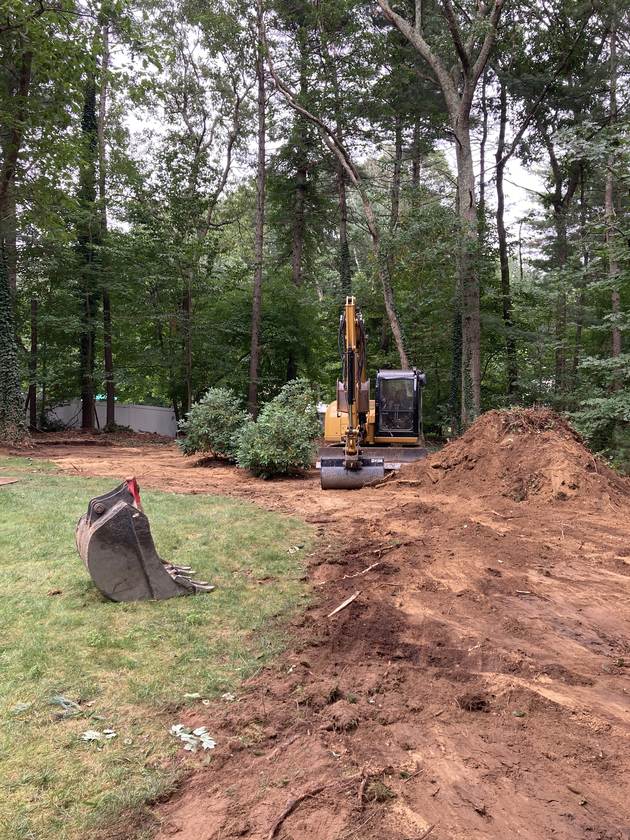
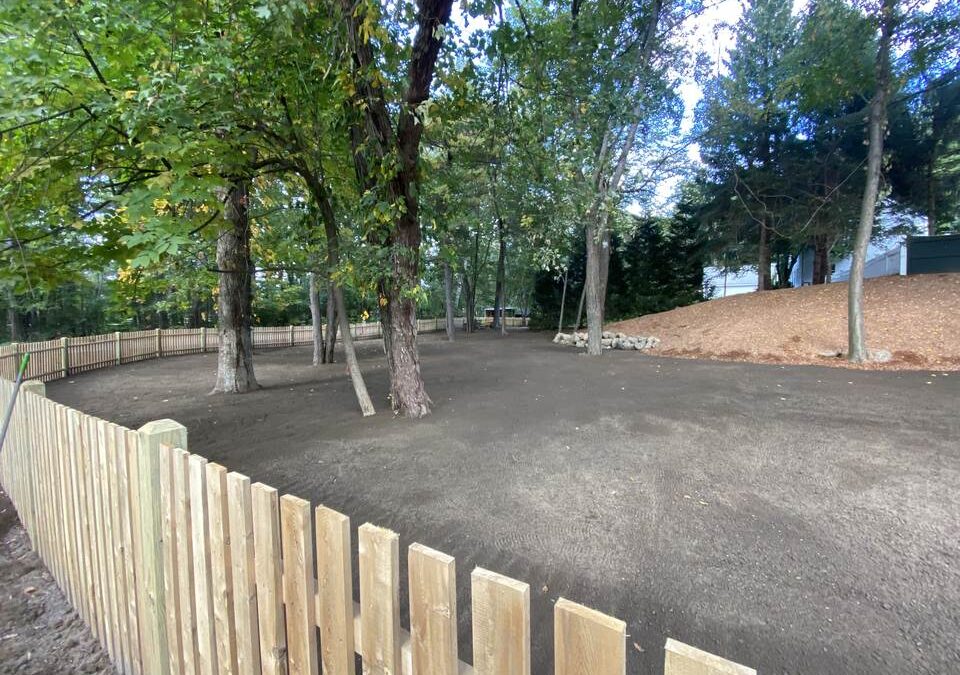
If the yard tilts toward the house, regrading is the honest fix. We strip the sod, bring in screened loam, and rebuild a slope of at least 2 percent away from the foundation. Low bowls in the middle of the lawn get filled and blended. Then we reseed or hydroseed. It is disruptive for a few weeks, but it solves the problem at its source. Our sitework crew handles grading with a skid steer and laser level so the slope is right.
French drains
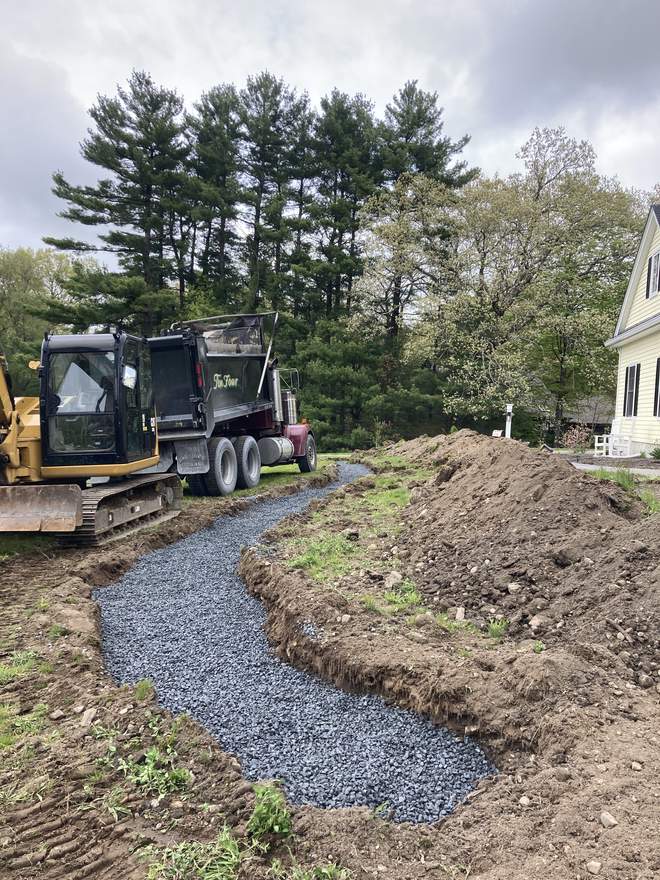
A French drain is a trench, usually 12 to 24 inches deep, lined with fabric, filled with crushed stone, and fitted with a perforated pipe. It intercepts water moving through the soil and carries it downhill. French drains are the workhorse for wet lawns on clay, soggy areas along a foundation, and water coming in from a neighbor’s yard. The key is that the pipe must have somewhere to go: a dry well, a catch basin, daylight, or a street drain where the town allows it.
Dry wells
A dry well is a buried pit filled with stone or a plastic chamber that holds water and lets it seep into the ground. Dry wells work well in sandy soil around Plainville and parts of Foxboro. They work poorly in tight clay, because the water just sits in the pit. So run the percolation test first. A dry well in soil that drains slower than a quarter inch an hour will overflow in every big storm.
Catch basins and channel drains
A catch basin is a grated box set at the lowest point of a lawn or patio. Water drops in and leaves through a buried pipe. Channel drains do the same job in a long slot across a driveway. Both are common where a patio or walkway has cut off the natural flow of water.
Swales and berms
A swale is a shallow, grassed ditch that carries water across a yard on the surface. It looks like a gentle dip in the lawn and mows normally. Swales are the cheapest way to move a lot of water on a large lot in Norfolk or Bellingham. A berm is the opposite: a low mound that blocks water. Together, they redirect runoff without any pipe.
Permeable pavers
If a driveway or patio sheds water onto the lawn, permeable pavers let rain drain straight through the joints into a stone base below. They cost more than standard pavers, but they turn a hard surface into a sponge.
What it costs to fix yard drainage in Wrentham and Norfolk County
These are typical ranges for the Wrentham and Norfolk County area. Every site is different, and access, soil, and pipe length change the number. Ledge, which is common in Wrentham and Franklin, can add cost when a trench hits rock.
Solution
Typical range
Downspout extensions (above ground)
$50 to $200 each
Buried downspout leader to pop-up emitter
$400 to $1,200 per run
Dry well (installed)
$1,200 to $3,500
French drain
$30 to $75 per linear foot
Catch basin with piping
$1,000 to $3,000
Grassed swale
$1,500 to $5,000
Regrading (typical yard)
$2,500 to $8,000
Permeable paver patio or driveway
$25 to $45 per sq ft
Most residential drainage projects in our area land between $3,000 and $12,000 once you combine two or three solutions. In short, it is not cheap, but it beats a finished basement that floods twice. We give a free written estimate for every job through our water and drainage solutions service.
Wetlands and conservation rules in Massachusetts
Here is the part many homeowners miss. Under the Massachusetts Wetlands Protection Act, any work within 100 feet of a wetland, stream, or pond falls under the local conservation commission. Wrentham, Norfolk, Foxboro, and Franklin all have active commissions and local bylaws that can be stricter than the state rule. Digging a trench, adding fill, or piping water toward a wetland inside that buffer needs a filing first.
That matters because many of the wettest yards in Norfolk County sit near a wetland. If a cattail patch, vernal pool, or brook sits behind your lot, assume the buffer applies. The Mass.gov wetlands regulations guide explains the process. A simple project may only need a Request for Determination, which takes a few weeks. A larger one needs a Notice of Intent.
Also, you cannot pipe your runoff onto a neighbor’s property or into a town storm drain without permission. Most towns allow a connection to a street catch basin, but ask the DPW first. We handle this paperwork as part of the job, and we will tell you up front if a filing is required.
When flooding is a foundation issue, not a yard issue
Sometimes the yard is only the symptom. If water shows up in the basement when the yard looks dry, or if foundation cracks are wider than a quarter inch, you may have a structural or groundwater problem. Likewise, a sump pump that runs constantly in a dry week points to a high water table, not surface runoff.
In that case, yard drainage helps but will not solve it alone. Interior perimeter drains, a new sump system, or foundation waterproofing come from a basement contractor, not a landscaper. However, the two go together. Fixing the outside first often cuts basement water in half. We are honest about which side of the line a problem falls on.
Red flags that call for a foundation contractor
Water entering through floor cracks or the wall-floor joint.
Horizontal cracks or bowing in a block foundation wall.
A sump pit that fills within minutes of being pumped.
Water in the basement during winter thaws with no surface pooling outside.
Mistakes to avoid
We see the same errors on repeat calls across Medway, Bellingham, and Franklin. First, never install a dry well without testing the soil. Second, do not run a French drain with no outlet; a pipe that ends in clay becomes a buried bathtub. Third, avoid corrugated black pipe for downspouts, because it crushes, clogs with roots, and cannot be snaked. Use solid PVC instead.
Another common mistake is piling mulch against the house until the grade rises above the foundation line. Keep at least six inches between soil and siding. Finally, do not fill a low spot with topsoil alone. Water will find it again unless the whole slope is corrected.
DIY vs hiring a pro
Some ways to fix yard drainage are easy weekend projects. Downspout extensions, cleaning gutters, and core aerating a compacted lawn need no special skills. A short French drain on flat ground is doable if you rent a trencher and understand slope. Plan on a fall of at least one inch per ten feet of pipe, or the water will not move.
Hire a pro for regrading, anything within a wetland buffer, projects that need a permit or a DPW connection, and any trench deeper than 18 inches. Digging in Massachusetts also means calling Dig Safe at 811 first. Rocky till makes hand digging slow and often hides ledge that stops a rental trencher. Seth has been solving these problems in Norfolk County since 2001, and he is on every job.
Maintenance once the system is in
A drainage system is not set-and-forget. Clean gutters every spring and fall so roof water reaches the leaders. Flush buried downspout lines with a hose once a year and check that pop-up emitters open. Rake leaves off catch basin grates in October and November. Every few years, run a hose into the French drain inlet and confirm water exits at the outlet.
Keep the lawn healthy, too. Core aeration each fall keeps the surface open, and thick turf absorbs far more rain than thin turf. Our property maintenance plans include these checks so small clogs never become a flooded yard again.
Frequently asked questions
How long does it take to fix yard drainage?
Downspout and dry well work takes one to two days. A French drain or catch basin system takes two to four days. Full regrading with new lawn runs one to two weeks.
Will a French drain work in clay soil?
Yes, as long as it has an outlet. The drain collects water that would otherwise sit on the clay and carries it away. It does not rely on the clay absorbing anything, which is why it beats a dry well in tight soil.
Can I fix yard drainage by just adding topsoil?
Only if the low spot is small and the rest of the yard drains well. Otherwise, water finds the next low spot. Correcting the overall slope is what lasts.
Does core aeration help a flooded lawn?
It helps with puddles that clear in a day, because it opens the sealed surface. It does not help with a high water table or a yard sloping toward the house.
What time of year is best for drainage work?
Late spring through fall, when the ground is workable. Diagnose during spring melt, then dig and regrade in summer before fall seeding.
Get a free written estimate to fix yard drainage
If your yard turns into a pond every spring, we can find the cause and lay out the fix. Call Seth at (508) 505-5416 or request a free written estimate online. We serve Wrentham, Norfolk, Franklin, Foxboro, Plainville, Medway, and Bellingham.
The best time to aerate and overseed your lawn in Massachusetts is late August through early October. Soil is still warm, nights are cooling, and weeds have slowed down, so new grass seed gets a clear head start. In Wrentham and the rest of Norfolk County, that window usually closes around Columbus Day, because seedlings need six to eight weeks of growth before the ground freezes.
Why early fall is the right time to aerate and overseed
Cool-season grasses like Kentucky bluegrass, fescue, and perennial ryegrass do most of their growing in spring and fall. However, spring seeding fights crabgrass, heavy rain, and summer heat. Fall seeding avoids all three. As a result, fall overseeding in Massachusetts usually produces two to three times the survival rate of spring seeding.
Soil temperature matters more than the calendar. Grass seed germinates best when the soil sits between 50 and 65 degrees. In Franklin and Norfolk, that usually means the last week of August through the first week of October. After that, cold nights slow germination, and a Halloween seeding often fails.
The ideal window by town
Most of our service area shares the same climate. For example, Wrentham, Plainville, and Foxboro typically see a first frost between October 5 and October 15. Medway and Bellingham sit a few miles inland and can run a couple of days earlier. Therefore, we aim to finish every aerate and overseed job by the first week of October.
If you miss the window, do not panic. Instead, consider a dormant seeding in late November once the soil drops below 40 degrees. The seed sits all winter and sprouts in April. It works, but results are less predictable than a proper fall seeding.
Core aeration vs spike aeration
Not all aeration is equal. Core aeration pulls plugs of soil two to three inches deep and drops them on the surface. Spike aeration simply pokes holes with solid tines. In compacted Norfolk County soil, spike aeration can actually make things worse, because it pushes soil sideways and tightens the walls of each hole.
Core aeration is the only method we recommend. It relieves compaction, opens channels for water and air, and creates thousands of seed-to-soil contact points. In short, if a company offers to aerate and overseed with a spike machine or “aeration shoes,” keep looking.
What a proper core aeration looks like
Plugs are two to three inches long and spaced two to four inches apart.
The machine makes at least two passes in different directions.
Plugs are left on the lawn to break down over one to two weeks.
Soil is moist but not soaked, so the tines can reach full depth.
A quick tip: water the lawn the day before if it has been dry. Dry, hard soil in late August will stop tines at one inch, and a shallow aeration wastes the effort.
Compaction and clay soil in Norfolk County
Much of Wrentham, Norfolk, and Franklin sits on glacial till. That means dense, rocky subsoil with pockets of heavy clay. In addition, most newer subdivisions along Route 1 and Route 140 were graded with construction equipment, and the topsoil was often thin to begin with. The result is a lawn that looks fine in May and turns hard and patchy by August.
Compaction blocks roots from reaching water and nutrients. Grass then grows shallow and burns out in the first heat wave. Because of this, lawns on clay or till should be aerated every year, not every two or three years. Sandy lawns closer to the Plainville and Foxboro line can often go every other year.
Signs your lawn is compacted
Water puddles or runs off instead of soaking in.
A screwdriver will not push more than an inch or two into the ground.
Grass thins under foot traffic, near driveways, and where kids play.
Moss or plantain weeds take over shaded or wet spots.
If you see two or more of these, core aeration should be a yearly habit. It pairs naturally with our lawn aeration and overseeding service, which we schedule as one visit.
Thatch and dethatching before you seed
Thatch is the spongy layer of dead stems and roots between the soil and the green blades. A half inch of thatch is healthy. More than that, however, blocks seed from touching soil and holds water like a sponge, which invites fungus. Bluegrass lawns and heavily fertilized lawns build thatch fastest.
To check, cut a small wedge from the lawn with a shovel and measure the brown layer. If it is over three quarters of an inch, dethatch first. A power rake pulls the layer up, and then you can aerate and overseed into clean soil. We handle this as a separate step in our dethatching service a few days before seeding.
One caution: dethatching in spring stresses the lawn before summer. Late August or early September is the better time, because the grass recovers quickly in cool weather.
Seed rates, seed types, and topdressing
Use the right amount of seed. Too little leaves thin spots, and too much crowds seedlings so they compete and die. For overseeding an existing lawn, the standard rate is 3 to 5 pounds of seed per 1,000 square feet. For bare areas, double it to 8 to 10 pounds per 1,000 square feet.
Which seed works in Massachusetts
A sun-and-shade mix of turf-type tall fescue, perennial ryegrass, and Kentucky bluegrass fits most yards in our area. Tall fescue handles drought and clay well, so it is the backbone of most of our blends. Fine fescue goes into shaded lots under oaks and pines. Meanwhile, avoid bargain seed that lists “annual ryegrass” or high weed seed percentages on the label.
The UMass Extension landscape program publishes seed guidance for New England lawns, and it is worth a look before you buy. Read the label for germination rate and the date tested. Fresh seed from this year germinates far better than a bag that sat in a garage.
Topdressing after seeding
Topdressing means spreading a thin layer of compost or screened loam over the seeded lawn. A quarter inch is plenty. It holds moisture around the seed, adds organic matter to clay soil, and fills the aeration holes with something better than what came out. On tough lawns, this single step makes the biggest difference in how thick the lawn comes in.
For larger renovations or a lawn that is more than half weeds, it may be smarter to start over. In that case, our hydroseeding service or a full lawn installation gives you a cleaner result than trying to overseed a failing lawn.
Watering and fertilizer after you aerate and overseed
Water is the number one reason fall seeding succeeds or fails. Seed must stay moist, not wet, until it sprouts. For the first two weeks, water lightly once or twice a day for 10 to 15 minutes per zone. Then, once you see green fuzz, switch to every other day for longer sessions. By week four, water deeply twice a week until the ground freezes.
September rain in Massachusetts helps, but do not count on it. A dry stretch of four or five days in the first two weeks will kill new seedlings. So set a timer, or ask us about a temporary irrigation setup.
Fertilizer timing
Apply a starter fertilizer on the same day you aerate and overseed. Starter blends carry extra phosphorus, which drives root growth. Massachusetts limits phosphorus use on established lawns, but the law allows it when you are seeding, so buy a product labeled for new seed. Then, around Thanksgiving, apply a winterizer fertilizer high in nitrogen. This feeds roots through the winter and gives you an early green-up in April.
Skip weed killers for at least six to eight weeks. Most pre-emergent and broadleaf herbicides will stop seed from germinating or damage young grass. If crabgrass is a concern, address it next spring, after the new lawn has been mowed three or four times. Our fertilizer programs are built around this schedule.
What to expect in the first weeks
Patience is part of the job. Here is a realistic timeline for a lawn seeded in early September in Wrentham or Norfolk.
Days 1 to 7: Plugs sit on the surface and start to crumble. The lawn looks rough, and that is normal.
Days 7 to 14: Perennial ryegrass sprouts first. You will see thin green hairs in the aeration holes.
Days 14 to 21: Tall fescue comes in. Bluegrass is slowest and may take up to 28 days.
Weeks 4 to 6: First mowing. Set the mower high, around three inches, and make sure the blade is sharp.
Weeks 6 to 8: The lawn fills in and the old thin spots start to disappear.
Keep foot traffic off seeded areas for the first three weeks. Also, hold off on fall leaf cleanup with heavy equipment until the grass has been mowed at least twice. A leaf blower is fine, but a rake will pull seedlings out. Our fall clean-up crews know how to work around freshly seeded lawns.
How often should you aerate and overseed?
For most lawns in Norfolk County, once a year in early fall is the right rhythm. Clay and high-traffic lawns benefit from annual core aeration and a light overseeding every year. A healthy lawn on sandy loam can stretch to every other year. In either case, do not skip more than two years, because compaction builds quietly and the lawn thins before you notice.
Some homeowners in Foxboro and Medway also ask about spring aeration. Spring core aeration is fine for compaction relief, but skip the seed. Instead, save overseeding for fall, when it actually takes.
Cost to aerate and overseed in Wrentham and Norfolk County
Prices below are typical ranges for the Wrentham and Norfolk County area. They vary by lot size, access, slope, and how much prep the lawn needs.
Service
Typical range
Core aeration only (up to 10,000 sq ft)
$150 to $300
Aeration and overseeding
$350 to $800
Add dethatching
$150 to $400
Add compost topdressing
$400 to $1,200
Full renovation (dethatch, aerate, seed, topdress)
$1,200 to $3,000
Larger properties in Norfolk and Bellingham with an acre or more of lawn will price higher, but the per-square-foot cost usually drops. We provide a free written estimate before any work starts, so there are no surprises.
DIY vs hiring a pro
You can rent a core aerator for about $90 to $130 a day from most equipment rental shops along Route 1. The machines weigh 250 to 300 pounds, so plan on two people to load it and a truck or trailer to haul it. Add seed, starter fertilizer, and compost, and a typical DIY job on a quarter-acre lot lands around $250 to $400 plus a full Saturday.
Hiring a pro costs more up front, but you get a heavier machine that pulls deeper plugs, quality seed at the correct rate, and someone who knows the timing. For example, we track soil temperature and the ten-day forecast, and we push jobs a few days if a heat wave or a soaking storm is coming. That judgment is what turns seed into lawn.
DIY makes sense for a small, flat, healthy lawn that just needs a boost. Hire a pro when the lawn is compacted clay, more than a third bare, on a slope, or larger than 10,000 square feet. Seth has been doing this since 2001, and he is on every job.
Frequently asked questions
Can I aerate and overseed in spring in Massachusetts?
You can, but success rates are lower. Spring seedlings face crabgrass competition and summer heat before their roots mature. If you must seed in spring, do it in late April and be ready to water all summer.
Should I mow before aerating?
Yes. Mow the lawn short, around two inches, a day or two before. Short grass lets the tines reach the soil and helps seed fall through to the ground instead of sitting on top of the blades.
Do I need to pick up the soil plugs?
No. Leave them. They break down within two weeks and return nutrients and microbes to the lawn. Mowing over them speeds it up.
What if it rains hard right after seeding?
Light rain is a gift. A downpour can wash seed into low spots on a slope. In that case, rake the washed seed back into place and reseed any bare streaks. Topdressing with compost helps hold seed in place on hills.
Will aeration help with grubs or drainage?
Aeration improves water infiltration, which helps mild drainage issues. It does not treat grubs, and it will not fix standing water caused by grading. For serious wet spots, see our water and drainage solutions.
Get a free written estimate to aerate and overseed this fall
The fall window in Norfolk County is short, and our schedule fills by mid-August. Call Seth at (508) 505-5416 or request a free written estimate online. We serve Wrentham, Norfolk, Franklin, Foxboro, Plainville, Medway, and Bellingham.
To answer how much mulch do you need, measure the bed in square feet, multiply by the depth in inches, and divide by 324. That gives you cubic yards. For example, a 300 square foot bed at 3 inches deep needs about 2.8 yards. Most beds in Wrentham and Norfolk County need a 2 to 3 inch layer, and you should top-dress with an inch or two every spring rather than strip and replace the whole bed each year.
How much mulch do you need: the cubic-yard formula
Mulch is sold by the cubic yard, and one cubic yard covers 324 square feet at 1 inch deep. From there, the math is simple. Measure the length and width of each bed in feet and multiply them to get square feet. Then multiply by the depth you want in inches. Finally, divide by 324.
Square feet x depth in inches / 324 = cubic yards
Here is how that plays out for a few common bed sizes around Franklin and Foxboro. These assume a fresh 3 inch layer on bare soil.
Bed size
Square feet
Yards at 2 inches
Yards at 3 inches
Small foundation bed (4 x 25 ft)
100
0.6
0.9
Front foundation bed (5 x 60 ft)
300
1.9
2.8
Island bed (15 x 20 ft)
300
1.9
2.8
Full front and side beds
800
4.9
7.4
Large property, all beds
1,500
9.3
13.9
Round up to the next half yard, because beds are never perfect rectangles. In addition, mulch settles as it is spread and watered in, so a slight surplus keeps you from running short. If a bed is an odd shape, break it into rectangles and triangles, estimate each one, and add them together.
Measuring odd-shaped beds
For a curved bed, pace off the longest length and the average width, then multiply. For a circle around a tree, measure the radius in feet, square it, and multiply by 3.14. A 5 foot radius circle is about 79 square feet, which needs roughly 0.7 yards at 3 inches. Most homeowners get how much mulch do you need wrong, so measure twice before you order.
How deep should mulch be?
Depth is the second half of how much mulch do you need. The right depth is 2 to 3 inches for most beds. That is deep enough to block light from weed seeds, hold soil moisture through a dry July, and keep root zones cooler. Go thinner than 2 inches and weeds push through. Go thicker than 4 inches and water and air struggle to reach the soil, which stresses shrubs and invites fungus.
Fine mulch (shredded hemlock, pine, double-ground bark): 2 to 3 inches. Fine material packs tighter, so it does not need to be as deep.
Coarse mulch (bark nuggets, wood chips): 3 to 4 inches. Chunky pieces leave gaps, so a thicker layer is needed to block light.
Around perennials and annuals: 1 to 2 inches. Deeper layers smother small plants and slow spring emergence.
Top-dressing an existing bed: 1 to 1.5 inches, just enough to refresh color and cover thin spots.
Depth matters more in New England than in milder climates. Our soil freezes and thaws repeatedly from December through March, and that heaving can push shallow-rooted perennials out of the ground. A steady 3 inch mulch layer insulates the soil, so temperatures swing less and roots stay put.
Bags vs bulk: how much mulch do you need to buy?
Once you have answered how much mulch do you need, the next question is how to buy it. Bagged mulch comes in 2 cubic foot bags. There are 27 cubic feet in a yard, so it takes 13.5 bags to equal one cubic yard. Bulk mulch arrives loose in a dump truck or is loaded into your pickup at the supply yard.
Bagged (2 cu. ft.)
Bulk (per yard)
Price per yard
$55–$95 (13.5 bags at $4–$7)
$35–$65 picked up
Delivery
Fits in a car trunk
$50–$100 per load, often free over 5 yards
Best for
Under 2 yards, touch-ups
3 yards and up
Downside
Plastic waste, hauling 40 bags
Pile on the driveway until spread
The break-even point sits around 2 to 3 yards. Below that, bags are convenient and you can buy a few at a time. Above that, bulk saves money and time, because you are not loading and lifting 40 bags of wet mulch. Most Wrentham homes with a full set of foundation beds need 4 to 8 yards, so bulk is usually the better call.
Mulch types common in Norfolk County
The mulch you choose changes both the look and the price. Around here, four types cover nearly every job, and all are sold by the yard.
Hemlock mulch
Hemlock is the classic New England bark mulch. It holds a rich reddish-brown color longer than most natural mulches. Because true hemlock is harder to source, many yards sell a hemlock blend. Expect $45 to $65 per yard for material and $85 to $130 per yard installed.
Pine and dark pine bark
Pine bark mulch is finer, breaks down a bit faster and feeds the soil as it does. It starts brown and fades to gray over a season. It is the most budget-friendly natural option, at roughly $35 to $50 per yard for material.
Black-dyed mulch
Black-dyed mulch is ground recycled wood colored with carbon-based dye. It gives beds a sharp, modern look and holds color well through the summer. However, it adds little to the soil, and the dye can stain a new patio or walkway if it is spread carelessly. Material runs $40 to $60 per yard.
Cedar mulch
Cedar lasts the longest and resists insects. It also costs the most, often $60 to $85 per yard, and its light color fades to silver. Cedar is a smart choice near a deck or foundation where you want the slowest breakdown.
Should you replace mulch every year?
No. In most beds, you should top-dress every spring and fully replace only every three to five years. Natural bark mulch breaks down into the soil, which is a good thing. It adds organic matter to the heavy clay and rocky fill under most yards from Plainville to Medway. Stripping it out every year throws that benefit away and doubles your cost.
Annual top-dressing
Each spring, rake the old mulch to break up any crust, pull weeds, and spread 1 to 1.5 inches of fresh material on top. This refreshes the color and brings the total depth back to 3 inches. A top-dress uses about half the mulch of a full install, so a bed that took 6 yards new needs only 3 yards to refresh.
When a full replacement makes sense
Replace everything when the old mulch has compacted into a mat that sheds water, when it has built up past 4 inches from years of adding, or when it is full of fungus, artillery mold or weed seed. Dyed mulch also tends to need full replacement more often, because it fades without breaking down. In short, check the depth before you order. If a screwdriver sinks 5 inches into old mulch, remove some before adding more.
Mistakes to avoid: skipping the edge and mulch volcanoes
Edge the beds first
Fresh mulch on a bed without a clean edge looks unfinished within a month. Edging cuts a 3 to 4 inch trench between lawn and bed, so mulch stays put and grass stops creeping in. It also gives the bed a defined shape, which is most of what people notice from the street.
Mark the bed line with a garden hose or marking paint.
Cut a vertical edge 3 to 4 inches deep with a flat spade or a bed edger.
Remove the sod strip and any grass roots that have crept into the bed.
Pull weeds and rake the old mulch level.
Then spread the new mulch, keeping it an inch below the lawn edge so it does not spill.
Edging is included in most professional mulch and edging quotes, and it is the step most DIY jobs skip. Doing it first also gives you an exact measurement, so you know exactly how much mulch you need before the truck shows up.
Never build a mulch volcano
Piling mulch against a tree trunk is the most common mulching mistake in Norfolk County. Those cone-shaped mounds, called mulch volcanoes, hold moisture against the bark. As a result, the bark rots, insects move in, and roots grow up into the mulch instead of down into the soil. Trees in newer Franklin and Bellingham subdivisions often show girdling roots from years of volcano mulching.
Instead, spread mulch in a flat donut. Keep it 3 to 6 inches away from the trunk so the root flare stays exposed. Extend the ring out to the drip line if you can, at 2 to 3 inches deep. The same rule applies to shrubs, because mulch packed against the base of a rhododendron or boxwood causes the same rot. For more on tree health, the UMass Extension landscape program publishes guidance written for Massachusetts conditions.
When to mulch in Massachusetts
The best window for spring mulching in the Wrentham area is late April through May. By then, the soil has warmed, spring bulbs are up, and the last frost date has passed or is close. Mulching in March traps cold in the soil and slows perennials. Mulching in June means fighting weeds that have already germinated.
Fall is the second good window. A fresh layer in October or November after clean-up insulates roots through the freeze and thaw cycle and looks tidy all winter. Meanwhile, avoid mulching in mid-summer drought, because dry mulch on dry soil does little. Many homeowners bundle mulching with their spring and fall clean-up so the beds are edged, weeded and mulched in one visit.
Mulch cost per yard installed in the Wrentham area
Installed mulch pricing around Wrentham, Norfolk and Foxboro typically runs $85 to $130 per cubic yard, including delivery, edging, spreading and clean-up. Material accounts for about $40 to $65 of that, and labor covers the rest. These are typical ranges for the area, and the final number depends on the material, bed access and how much prep the beds need.
Job size
Yards
Typical installed cost
Small foundation beds
2–3
$250–$400
Full front and side beds
5–7
$450–$850
Large property, all beds
10–15
$900–$1,800
Prices go up when beds are far from the driveway, on a slope, or behind a fence, because every yard has to be wheelbarrowed by hand. They also go up when old mulch has to be removed and hauled away, usually $30 to $50 per yard extra. Prices come down when the beds are already edged and weeded, or when mulching is part of a larger property maintenance plan.
DIY mulching vs hiring a pro
Spreading mulch is one of the more DIY-friendly landscape tasks. If you know how much mulch you need, have 3 yards or less, and own a wheelbarrow and a bow rake, you can do it in a Saturday. The material alone will cost $150 to $250, plus delivery.
The math changes above 5 yards. A crew with a dump trailer and three people spreads 10 yards in a few hours, edges every bed and leaves the driveway clean. Doing the same job alone takes a full weekend. Hiring also makes sense when the beds need new plantings, a fresh edge or drainage fixes at the same time, since one crew can handle the planting and the mulch together.
Frequently asked questions
How many bags of mulch equal one cubic yard?
It takes 13.5 bags of 2 cubic foot mulch, or 9 bags of 3 cubic foot mulch, to make one cubic yard. So a 3 yard job means roughly 40 standard bags.
How much mulch do you need for a 10 x 10 bed?
A 10 by 10 foot bed is 100 square feet. At 3 inches deep, that is 100 x 3 / 324, or about 0.9 cubic yards. Order one full yard and you will have a little left for touch-ups.
Does mulch attract termites?
Mulch itself does not attract termites, but a thick layer piled against a foundation gives them cover. Keep mulch 6 inches below siding and pull it back from the foundation a few inches.
Can I put new mulch over old mulch?
Yes, if the old layer is under 2 inches and not compacted. Rake it loose first, then add 1 to 1.5 inches on top. If the total would exceed 4 inches, remove some old material first.
Is dyed mulch safe for plants and pets?
Black and brown dyed mulches use carbon or iron oxide dye, which is safe. The concern is the wood source, so buy from a supply yard that uses clean, untreated wood instead of shredded pallets.
Get a free written estimate for mulch and edging
Still asking how much mulch do you need, or which type fits your beds? Ten Four Landscape & Construction edges, weeds and mulches beds across Wrentham, Norfolk, Franklin, Foxboro, Plainville, Medway and Bellingham, and Seth measures every bed himself. Call (508) 505-5416 or request a free written estimate online and we will put the yardage and price in writing.
The typical lawn care cost per month in Massachusetts runs $160 to $400 for weekly mowing on a standard quarter-acre lot, and $250 to $600 per month once you add a fertilizer program, spring and fall clean-ups and other seasonal work. The numbers below are typical ranges for the Wrentham area, and your quote will depend on lot size, terrain and what you want included.
Lawn care cost per month: the quick numbers
Lawn care pricing in our area breaks into two buckets: the weekly mowing visit, and everything else that keeps a lawn healthy through a New England year. Here is what a typical Wrentham, Franklin or Foxboro homeowner pays for each.
Service
Typical price
Monthly equivalent
Weekly mowing (1/4 acre)
$40–$65 per visit
$160–$280
Weekly mowing (1/2 acre)
$60–$95 per visit
$240–$400
Weekly mowing (1 acre)
$95–$150 per visit
$380–$650
Fertilizer program (5–6 apps)
$65–$120 per app
$50–$90 averaged
Spring clean-up
$250–$600 one time
$30–$70 averaged
Fall clean-up
$300–$800 one time
$35–$95 averaged
Aeration and overseeding
$250–$600 one time
$30–$70 averaged
So a full-service package on a quarter-acre lot usually totals $3,000 to $5,500 per season. Spread over the roughly eight months we work in Massachusetts, that is $375 to $690 per month. If you only want mowing, the lawn care cost per month drops to the $160 to $280 range. In short, the “everything else” nearly doubles the bill, but it is also what separates a green lawn from a weedy one.
What a monthly mowing price includes
A standard mowing visit is more than cutting grass. For example, a proper visit from our lawn mowing crew includes mowing at the correct height, string trimming along fences and beds, edging hard surfaces and blowing clippings off walks and driveways. That takes a two-person crew about 20 to 40 minutes on a typical lot.
Most companies charge extra for bagging clippings, mowing through heavy leaf drop or cutting grass that has grown a foot tall. As a result, always ask what a visit covers before you compare two quotes. A $45 visit that skips trimming is not cheaper than a $55 visit that does the whole job.
Weekly vs biweekly mowing
Many homeowners ask about biweekly mowing to cut the lawn care cost per month in half. It rarely works out that way. In May and June, cool-season grass in Massachusetts grows two to three inches a week, so a biweekly cut stresses and clumps the lawn. Because of that, most companies charge 25 to 50 percent more per biweekly visit, and some will not offer it during peak growth.
How lot size changes your lawn care cost per month
Lot size is the biggest single factor, but it is not a straight line. A crew’s drive time, unloading and set-up cost the same on every stop, so small lots pay more per square foot. Here is how pricing tiers usually shake out around Wrentham and Norfolk.
Under 5,000 sq. ft. of turf: $40 to $50 per visit. Common in older neighborhoods near Wrentham center and in Plainville.
5,000 to 10,000 sq. ft.: $50 to $65 per visit. The typical subdivision lot in Franklin, Medway and Bellingham.
10,000 to 20,000 sq. ft.: $65 to $95 per visit. Half-acre lots off Route 1A and along the Foxboro line.
Over one acre: $95 to $150 or more, quoted per site after a walk-through.
Note that “lot size” means mowable turf, not deed acreage. A one-acre parcel in Norfolk with a house, driveway, pool and half an acre of woods might only have 12,000 square feet of grass. Therefore, a good estimator measures the actual turf before quoting.
Seasonal programs: what fertilizer, aeration and clean-ups cost
Mowing keeps a lawn neat. The seasonal program keeps it alive. New England lawns face crabgrass in June, drought in July, grubs in August and a long freeze from December through March. Each problem has a scheduled fix, and each fix adds to your lawn care cost per month.
Fertilizer and weed control
A standard fertilizer program in Norfolk County runs five or six applications from April through November. Expect $65 to $120 per application on a quarter-acre lot, or roughly $400 to $650 per season. That covers pre-emergent crabgrass control in spring, slow-release nitrogen through the summer, grub control in July and a winterizer feeding in late fall. Programs with lime, organic products or extra broadleaf treatments cost more.
Aeration, overseeding and dethatching
Massachusetts soil is heavy, and the glacial clay and rock under most Wrentham yards compacts hard. Core aeration opens it up, and overseeding right afterward thickens thin turf. Aeration and overseeding together run $250 to $600 on a typical lot, and early fall is the right time. Dethatching, if your lawn needs it, adds another $150 to $400.
Spring and fall clean-ups
Clean-ups are billed by the hour or by the job. A spring clean-up removing winter debris, cutting back perennials and edging beds usually costs $250 to $600. Fall clean-ups cost more, because oak and maple leaves keep falling for six weeks and often need two or three visits. Budget $300 to $800 for a full spring and fall clean-up package, more on heavily wooded lots in Norfolk and Foxboro.
Add-ons that change the lawn care cost per month
Beyond turf, most homeowners add a few extras during the season. None are required, but they are the items that most often surprise people on the first invoice. Here are typical add-on prices for the Wrentham area.
Mulch installed: $85 to $130 per cubic yard, including edging beds first. A typical front foundation bed takes 3 to 6 yards.
Shrub pruning: $75 to $150 per hour for a two-person crew, or a flat price per property. Most homes need one or two prunings a year.
Tick and mosquito spraying: $75 to $150 per treatment, usually every three to four weeks from May through September.
Bed weeding: $60 to $100 per hour, often bundled into the mowing visit for a small monthly bump.
Irrigation start-up and blow-out: $75 to $150 each, spring and fall.
Tick spraying deserves a special note in Norfolk County. Our towns sit in one of the highest Lyme disease areas in the state, and deer travel freely through wooded lots along the Foxboro and Plainville lines. Many families consider mosquito and tick spraying the best money they spend all summer.
Annual contract vs per-visit pricing
You can buy lawn care two ways. First, you can pay per visit, with each mow and application billed as it happens. Second, you can sign an annual agreement that bundles the season into equal monthly payments. Both work, but they suit different homeowners.
Per-visit pricing
Per-visit pricing is simple and flexible. You pay only for work done, and you can pause during a dry August when the grass stops growing. However, per-visit customers usually pay 10 to 15 percent more per service. They also drop to the bottom of the schedule when a company is busy, because contract customers are routed first.
Annual contracts
An annual contract spreads a $4,000 season into eight or twelve equal payments, so your lawn care cost per month is predictable. Contract customers get a fixed spot on the route, priority after storms and usually a discount for bundling. The trade-off is commitment. Read the terms, because some contracts include a set number of mows and charge extra beyond that, while others include unlimited weekly cuts.
For most families in Franklin, Medway and Wrentham who want a hands-off lawn, the contract wins. If you travel a lot, own a rental or just want the grass cut, per-visit pricing gives you more control.
What makes a quote higher or lower in Norfolk County
Two neighbors on the same street can get very different quotes for the same size lawn. Crews price by time, and the following details change how long your yard takes.
Slope and terrain: Hillside lots in Norfolk and the rocky ridges off Route 1 need walk-behind mowers instead of a 60-inch zero-turn. That can double the mow time.
Obstacles: Every tree, bed, swing set and fence post adds trimming. Twenty trees in the lawn can add $10 to $15 per visit.
Gates and access: A backyard behind a 36-inch gate rules out a large mower. Narrow access means a smaller machine and more passes.
Route density: A company with six customers on your street can price lower than one driving from two towns away. Ask who else they service nearby.
Insurance and licensing: Massachusetts requires a pesticide applicator license for fertilizer and weed control. Licensed, insured companies cost more than a guy with a truck, and for good reason.
On the lower side, an open, flat lot with few beds and easy road access is the cheapest lawn to maintain, especially when the crew is already parked on your street.
DIY lawn care vs hiring a pro: the real cost comparison
Plenty of homeowners mow their own lawns, and that is a fine choice. However, the DIY lawn care cost per month is higher than most people think once you add up equipment, supplies and time. Here is an honest comparison for a quarter-acre lot.
Item
DIY cost
Notes
Mower (gas or battery)
$400–$1,200
Riding or zero-turn: $2,500–$5,000
String trimmer and blower
$250–$600
Battery models need spare packs
Fuel, blades, oil, maintenance
$100–$200 per year
Blade sharpening twice a season
Fertilizer and weed control
$150–$300 per year
Retail products, four to five bags
Aerator rental
$90–$130 per day
Plus seed, $60–$120
Your time
60–90 hours per season
Mowing, trimming, clean-ups, applications
Spread the equipment over five years and add supplies, and DIY lawn care runs about $60 to $120 per month before you count your time. A pro service on the same lot runs $160 to $280 per month for mowing alone. Therefore, doing it yourself saves real money, roughly $1,000 to $2,000 per year, if you have the weekends and the storage space.
When hiring a pro makes more sense
The math flips on larger lots, on slopes and for anyone who wants the fertilizer program done right. Store-bought products applied at the wrong time do little, and a pre-emergent put down two weeks late will not stop crabgrass. Meanwhile, a licensed applicator carries better products and a calendar tuned to our climate. The UMass Extension landscape program publishes timing guidance for Massachusetts, and it is worth reading even if you go the DIY route.
Hiring also makes sense if your lawn needs repair. A yard with bare patches, drainage problems or compacted fill from a new build needs more than mowing, so a property maintenance plan that combines mowing, feeding and seasonal work will outperform a weekend routine.
Mistakes that raise your lawn care bill
Some of the most expensive lawn problems in Norfolk County are self-inflicted. First, mowing too short. Cutting below three inches in summer exposes soil, invites crabgrass and forces more watering. Next, skipping fall work. Fall is when cool-season grass builds roots, so a missed September overseeding shows up as a thin lawn the following June.
Another common mistake is chasing the lowest per-visit price. A crew that scalps the lawn and skips trimming costs less per mow and more per year. Finally, ignoring irrigation. A lawn that gets an inch of water per week through July needs far less repair in August.
Frequently asked questions
How much does lawn mowing cost per week in Massachusetts?
Most Norfolk County homeowners pay $40 to $65 per weekly mow on a quarter-acre lot, and $60 to $95 on a half acre. Prices include trimming, edging and blowing off hard surfaces.
How many months a year do you pay for lawn care?
The mowing season in Massachusetts runs from mid-April through early November, about 28 to 30 cuts. Annual contracts often spread that cost over 12 months so your payment stays the same all year.
Is a lawn fertilizer program worth the cost?
Yes, for most lawns. A $400 to $650 program prevents the crabgrass, grubs and thin turf that cost far more to fix later, and healthy roots hold moisture better in our clay soils.
Do lawn care companies charge extra for the first cut of the season?
Often, yes. The first cut in April may include a spring clean-up or a double cut if the grass is long, and it is usually billed as a one-time charge of $100 to $250 before regular weekly pricing starts.
Can I get a lawn care quote without a site visit?
Some companies quote from satellite images, but a walk-through is more accurate. Slope, gates, tree count and turf condition all change the price, and none show well from above.
Get a free written estimate for your lawn
Want a real number instead of a range? Ten Four Landscape & Construction mows, feeds and maintains lawns across Wrentham, Norfolk, Franklin, Foxboro, Plainville, Medway and Bellingham, and Seth walks every property himself before quoting. Call (508) 505-5416 or request a free written estimate online and we will put your lawn care cost per month in writing.
If you are wondering how often to mow your lawn in Massachusetts, the short answer is once a week from late April through October, and every 5 days during the May growth surge. Cut cool-season grass to 3 to 3.5 inches and never remove more than a third of the blade at once. That one-third rule, not the calendar, is what really decides when the mower comes out.
How often to mow your lawn through the New England season
Lawns in Norfolk County are almost all cool-season grass: tall fescue, Kentucky bluegrass, perennial rye and fine fescue. These grasses grow fastest when air temperatures sit between 60 and 75 degrees. As a result, growth explodes in May, slows in July heat, and picks up again in September.
Your mowing schedule should follow that curve, so how often to mow your lawn changes month to month. Here is what a typical year looks like in Wrentham, Franklin and Foxboro.
Period
Growth rate
Mow every
Mid-April to early May
Waking up
7–10 days
May to mid-June
Peak
4–5 days
Late June to August
Slow, may go dormant
7–14 days
September to mid-October
Second peak
5–7 days
Late October to November
Slowing down
10–14 days
Over a full season that works out to 26 to 32 mows for most yards. Irrigated lawns on a fertilizer program land at the high end. Unwatered lawns that brown out in July land at the low end.
The one-third rule decides how often to mow your lawn
Every guide on how often to mow your lawn comes back to the same principle. Never cut off more than one-third of the grass blade in a single mow. If your target height is 3 inches, mow when the grass reaches 4 to 4.5 inches. If the target is 3.5 inches, mow at about 5 inches.
Why does it matter? Grass stores energy in its blades. Cutting off half the plant at once shocks it, stops root growth for days, and opens the canopy to weeds and sun scald. In addition, the pile of long clippings you leave behind smothers the grass underneath.
What to do when you fall behind
Vacations happen, and a rainy week in May can leave you with 7-inch grass. Do not scalp it back to 3 inches in one pass. Instead, raise the deck to its highest setting and mow. Then wait two or three days and drop it one notch. Repeat until you are back at your normal height. It takes an extra week, but the lawn will thank you.
How short to cut cool-season grass
Height matters as much as how often to mow your lawn. For the fescue and bluegrass blends that cover most Norfolk County yards, 3 to 3.5 inches is the sweet spot. Taller grass shades the soil, keeps roots cooler, blocks crabgrass seed from germinating, and grows deeper roots that survive July droughts.
Many homeowners in Plainville and Medway cut at 2 inches because it looks tidy for a day or two. However, short grass dries out faster, thins out by August and invites weeds. A lawn kept at 3.5 inches looks just as neat when it is cut on time, and it stays green two to three weeks longer in a dry summer.
Mowing heights by season
First mow of spring (April): 2.5 to 3 inches, to clear winter matting and let sun warm the soil.
Late spring (May–June): 3 inches.
Summer (July–August): 3.5 to 4 inches. Raise the deck to protect roots from heat.
Fall (September–October): Back to 3 inches as growth picks up.
Last mow (November): 2.5 inches, to prevent snow mold under a winter blanket.
Fine fescue in shady areas can go a half inch taller than these numbers. Newly seeded lawns should not be mowed until they reach 3.5 to 4 inches, and then only with a sharp blade on dry ground.
When to start and stop mowing in Massachusetts
Knowing how often to mow your lawn also means knowing when to start. The first mow in Wrentham usually lands in the third or fourth week of April, once the grass has grown about an inch from its dormant height. Do not rush it. Mowing wet, soft April ground with a heavy mower leaves ruts that last all year. Wait for a dry stretch and firm footing.
The last mow comes after growth stops, which is typically the second or third week of November in Norfolk County. Our average first frost is around October 10 to 15, but grass keeps creeping until soil temperatures drop into the 40s. Drop the deck to 2.5 inches for that final cut, and make sure leaves are cleared first. Pairing that last mow with a fall clean-up saves a trip.
Sharp blades, clippings and other details that matter
How often to mow your lawn is only half the equation. How you mow changes the result just as much.
Keep the blade sharp
A dull blade tears grass instead of cutting it. The torn tips turn brown within a day, so the whole lawn looks hazy and stressed. Torn blades also lose more water and let in disease. Sharpen the blade every 20 to 25 hours of mowing, which is roughly twice a season for a half-acre lot. A sharpening service in Franklin or Foxboro charges about $10 to $20 per blade, or you can do it with a file in ten minutes.
Leave the clippings
Mulching clippings back into the lawn is free fertilizer. Clippings are about 4 percent nitrogen and break down in a week or two. Over a season they return roughly one full fertilizer application, which is worth about $60 to $80 in bagged product. They do not cause thatch, despite the old myth; thatch comes from roots and stems, not leaf tissue. The only time to bag is when grass is very long, wet and clumping, or when you are dealing with a fungal outbreak.
Clean the deck
Grass builds up under the deck and cuts airflow, so the mower stops lifting blades for a clean cut. Scrape it out every few mows, and always after a wet cut. A clean deck also mulches clippings finer, so they disappear into the lawn faster.
Change direction each time
Mowing the same pattern every week trains grass to lean one way and compacts the soil under the wheel tracks. Alternate between north-south, east-west and diagonal passes. It also gives the striped look you see on well-kept lawns along Route 1A in Norfolk.
Mowing wet grass, drought and other tricky situations
Wet grass
Avoid it if you can. Wet grass clumps, clogs the deck, cuts unevenly and spreads fungal disease. Wet soil also compacts under the mower. If a rainy stretch leaves no choice, raise the deck a notch, slow down, and clean the deck afterward. Mowing at 4 p.m. after a morning rain usually works better than mowing at 8 a.m.
Summer drought
Cool-season grass slows or goes dormant when July temperatures hit the upper 80s and rain stops. A dormant lawn is tan but alive. Mow it less often, every 10 to 14 days, and only to remove seed heads and weeds. Raise the deck to 4 inches, and never mow in the heat of the afternoon. The UMass Extension turf program has good guidance on managing lawns through Massachusetts droughts.
Newly seeded or sodded lawns
Wait until new grass is 3.5 to 4 inches tall, usually three to four weeks after a September seeding. Mow on dry ground with a sharp blade at 3 inches. Sod can be mowed once it resists a gentle tug, about two to three weeks after installation.
Slopes and rocky spots
Plenty of Norfolk County yards sit on ledge or glacial till. Mow across a slope with a walk-behind, never up and down, and raise the deck over shallow rock so the blade does not strike. Bare, rocky strips along a retaining wall are often better mulched than mowed.
Edging and trimming: the finishing step
A lawn mowed at the right height still looks unfinished if the edges are ragged. Edge along walkways, driveways and beds every second or third mow with a stick edger or a string trimmer turned on its side. Trim around trees, fences and mailboxes every mow, but keep the trimmer head level so you do not scalp a ring around each post.
Keep a clean, deep bed edge around plantings. It stops grass from creeping into mulch, and it makes the mowing line obvious so nobody has to guess where the lawn ends.
Common mowing mistakes to avoid
Cutting too short. The number one cause of thin, weedy lawns in Massachusetts. Stay at 3 inches or higher.
Mowing on a fixed day no matter what. Follow the one-third rule, not the calendar.
Running a dull blade all season. Brown tips and disease follow.
Bagging every clipping. You are throwing away free nitrogen.
Mowing wet April soil. Ruts and compaction last all year.
Skipping the last mow. Long grass under snow gets matted and moldy.
Same pattern every week. Wheel ruts and leaning grass.
What weekly lawn mowing costs in Norfolk County
Many homeowners eventually ask whether it is worth paying someone to handle this every week. Here are typical ranges for weekly mowing in the Wrentham, Franklin and Foxboro area. Prices vary by lot size, obstacles, slope and how much trimming and edging is included.
Lot size
Per visit
Per season (28 visits)
Under 1/4 acre
$45–$65
$1,260–$1,820
1/4 to 1/2 acre
$60–$90
$1,680–$2,520
1/2 to 1 acre
$85–$130
$2,380–$3,640
Over 1 acre
$120 and up
$3,360 and up
A standard visit includes mowing, string trimming, edging every other week and blowing off walks and driveways. Most companies in the area run a 26 to 30 visit season from late April through mid-November. Bi-weekly service usually costs 20 to 30 percent more per visit, because the grass is longer and takes more time. For comparison, a decent self-propelled mower runs $400 to $700, plus gas, blade sharpening and roughly 30 hours of your Saturdays each season.
When a full maintenance program makes sense
Weekly lawn mowing service on its own solves the time problem. A full property maintenance program solves the results problem. It bundles mowing with spring and fall clean-ups, fertilizer and weed control, aeration and overseeding, and mulch and bed care on one schedule.
A program makes the most sense when your lawn has stopped responding to mowing alone. If it thins out every August, if crabgrass takes over the edges, or if you are spending more on bagged fertilizer than the program would cost, bundle it. In Norfolk County, a full program for a half-acre lot typically runs $3,500 to $6,000 per season, depending on what is included. It also means one crew that knows your yard and adjusts how often to mow your lawn as the weather changes, instead of a fixed Tuesday whether the grass needs it or not.
Frequently asked questions
How often should you mow your lawn in the summer?
Every 7 to 10 days in a normal summer, and every 10 to 14 days during a drought when growth slows. Raise the deck to 3.5 or 4 inches from July through August.
Is it better to mow more often or let grass grow longer?
More often, with less taken off each time. When people ask how often to mow your lawn, that is the real answer. Frequent light cuts keep the plant healthy. Letting grass get long and then cutting it short is the most stressful thing you can do to it.
What height should I cut my grass in Massachusetts?
Three to 3.5 inches for most of the season, up to 4 inches in summer heat, and down to 2.5 inches for the first and last mow of the year.
Should I mow before or after fertilizing?
Mow first, then fertilize a day or two later. That way the granules reach the soil and you are not mowing for another five to seven days.
Can I mow every day?
You can, but it is pointless. Grass grows about a quarter inch a day at peak, so every 4 to 5 days in May is the most any Norfolk County lawn needs.
Get a free written estimate for weekly mowing
Whether you want weekly mowing or a full maintenance program, Ten Four Landscape & Construction serves Wrentham, Norfolk, Franklin, Foxboro, Plainville, Medway and Bellingham, and Seth is on every job. Call (508) 505-5416 or request a free written estimate online and we will put your yard on the schedule.
The best time to seed a lawn in Massachusetts is mid-August through late September. Soil is still warm, nights are cooling, and weeds have mostly stopped germinating, so new grass gets a six to eight week head start before the first frost. Spring is a workable second choice, but a fall seeding in Norfolk County will almost always come in thicker and hold up better through its first summer.
Why late summer is the best time to seed a lawn in Massachusetts
Cool-season grasses do most of their growing when air temperatures sit between 60 and 75 degrees. In Wrentham and Franklin, that window opens in late August and runs into October. Meanwhile, the soil is still holding summer heat, which is exactly what seed needs to sprout fast.
Three other reasons make fall the winner. First, crabgrass and most annual weeds stop germinating once nights drop into the 50s, so your seedlings are not fighting for space. Second, rainfall picks up and evaporation drops, so watering is easier. Finally, new grass gets two growing seasons, fall and the following spring, before it faces July heat.
The ideal window by date
August 15 to September 15: Prime time. Seed sprouts in 7 to 14 days and roots deeply before the ground cools.
September 15 to September 30: Still very good. Ryegrass and fescue establish fine; bluegrass gets a little tight.
October 1 to October 15: Risky. Fast-germinating rye can work, but bluegrass often runs out of time.
After mid-October: Too late. Wait for dormant seeding or spring.
Our average first frost in Norfolk County lands around October 10 to 15, so count backward six weeks from there. That math is why so many pros call Labor Day weekend the best time to seed a lawn in New England.
Soil temperature matters more than the calendar
Dates are a guide, but soil temperature decides the best time to seed a lawn. Cool-season seed germinates best when soil stays between 50 and 65 degrees at a 2-inch depth. In late August the soil in Foxboro is usually around 70 and dropping, which is perfect. By late October it is in the 40s, and germination slows to a crawl.
Check with a cheap soil thermometer from any hardware store. Push it 2 inches into the ground in the morning for three days in a row. If the readings average 55 or higher and are trending down, go ahead and seed. If they are trending up in spring, wait until they pass 50 consistently.
How different seed types respond
Grass type
Germination
Best seeding cutoff
Perennial ryegrass
5–10 days
Early October
Turf-type tall fescue
7–14 days
Late September
Fine fescue
7–14 days
Late September
Kentucky bluegrass
14–30 days
Mid-September
Because bluegrass is so slow, it needs the earliest start. A blend that leans on rye and fescue buys you an extra two weeks at the back end of the season.
Is spring the second-best time to seed a lawn?
Spring is the second-best time to seed a lawn, and sometimes it is the only option. If you finished a patio or walkway project in April and have bare dirt, you should not leave it exposed until August. Seed it in spring and plan to overseed in fall.
The trouble with spring is timing. Soil in Norfolk County does not hit 50 degrees until late April or early May. By then crabgrass is also germinating, and pre-emergent crabgrass control will block your grass seed too. In addition, seedlings that sprout in May have only six to eight weeks before June heat and drought arrive.
How to make a spring seeding work
Seed between April 20 and May 15, once soil holds 50 degrees.
Skip standard crabgrass pre-emergent, or use a mesotrione product labeled safe for new seed.
Lean on tall fescue and ryegrass, which handle summer stress better than bluegrass.
Water more often through June and July than you would for a fall seeding.
Summer is never the best time to seed a lawn in Massachusetts. Soil temperatures in July push past 80 degrees, seedlings dry out in hours, and crabgrass outruns everything. If you must patch a spot in summer, use sod for that area instead, or run a sprinkler three times a day and accept some loss.
Winter is a different story. Dormant seeding means spreading seed in late November or December, after the ground is too cold to germinate but before it freezes solid. The seed sits through winter, works into the soil with freeze-thaw cycles, and sprouts as soon as March soil warms. It is not as reliable as fall, but it beats waiting until May.
Dormant seeding tips for Norfolk County
Wait until soil is below 40 degrees so seed does not sprout and then freeze.
Rake seed into bare soil; it will not survive sitting on top of frozen ground.
Expect 60 to 70 percent of normal germination, so bump your rate by a third.
Skip it on slopes, because spring runoff will carry the seed downhill.
Best grass seed for Norfolk County lawns
Choosing the right seed is as important as choosing the best time to seed a lawn. Our soil around Wrentham, Plainville and Bellingham runs from sandy glacial outwash to heavy clay with plenty of rocks. Most yards also mix sun and shade under mature oaks and pines, so a blend beats a single species.
Turf-type tall fescue (40–50%): Deep roots, drought tolerant, handles dogs and kids. Our workhorse for full sun.
Kentucky bluegrass (20–30%): Spreads by rhizomes to heal thin spots. Needs sun and steady water.
Perennial ryegrass (15–20%): Sprouts fast to hold soil while the others catch up.
Fine fescue (10–20%): The only grass that thrives under oaks and along wooded lot lines.
Buy seed with a purity of 95 percent or better and a weed seed content of 0.1 percent or less. The label will list both. Cheap “contractor mix” often has 30 percent annual ryegrass, which dies after one year and leaves holes. The UMass Extension landscape program publishes seed guidance for Massachusetts if you want to dig deeper.
How to prep your yard before you seed
Seed thrown on hard, compacted ground will not do much no matter when you spread it. Good prep is the difference between a 40 percent take and a 90 percent take. Here is the order we follow on a Medway or Norfolk lawn renovation.
Test the soil. Most Norfolk County soil is acidic, around pH 5.5. Grass wants 6.2 to 6.8, so a lime application is almost always part of the job.
Kill or remove what is there. For a full renovation, spray weeds two weeks ahead, then dethatch or strip the dead layer.
Loosen the top 2 to 4 inches. Core aerate for overseeding, or rototill and rake for bare ground.
Add loam or compost. Spread a half inch of screened compost or 4 to 6 inches of loam on raw fill.
Grade and firm. Rake smooth, fill low spots, and roll lightly so footprints sink about a quarter inch.
Spread seed. Use a broadcast spreader at 6 to 8 pounds per 1,000 square feet for bare ground, half that for overseeding.
Rake and cover. Lightly rake so seed sits in the top quarter inch, then cover with peat moss or a thin layer of straw.
Apply starter fertilizer. A high-phosphorus starter like 18-24-12 gives roots a boost. Massachusetts limits phosphorus on lawns, but new seedings are exempt.
Seed rate quick reference
Situation
Pounds per 1,000 sq. ft.
Bare soil, fescue blend
6–8
Bare soil, bluegrass heavy
3–4
Overseeding thin lawn
3–4
Dormant seeding
8–10
Watering schedule for a newly seeded lawn
Water is where most seedings fail. The top half inch of soil must stay damp until the seed sprouts. After that, you coax roots deeper with longer, less frequent watering.
Days 1–14: Water two or three times a day for 5 to 10 minutes per zone. Morning, midday and late afternoon. Never let the surface go pale and dry.
Days 14–28: Once a day, 15 to 20 minutes, as seedlings reach 1 to 2 inches.
Weeks 4–8: Every other day, 30 minutes, to push roots down.
After 8 weeks: One inch per week total, from rain or irrigation, in one or two deep soakings.
In a typical September in Wrentham, rain covers about a third of that. So plan on running hoses or sprinklers most days for the first month. If you have an irrigation system, set a temporary “new seed” program and switch it back in October.
First mow and first fertilizer
Mow for the first time when the new grass reaches 3.5 to 4 inches, usually three to four weeks after seeding. Set the mower at 3 inches, make sure the blade is sharp, and mow when the ground is dry so the wheels do not tear seedlings out. Then, about four weeks after seeding, apply a second round of fertilizer at half rate. A winterizer application in mid-November finishes the season.
Overseeding vs full lawn renovation
Not every lawn needs to start from scratch. If at least half of what you see is desirable grass, overseed. If more than half is weeds, bare dirt or dead patches, renovate.
Overseeding means core aerating the existing lawn and spreading seed over it, usually in early September. It costs roughly $150 to $400 per 5,000 square feet in the Wrentham and Franklin area, and it thickens a thin lawn without disrupting the yard. It is the best time to seed a lawn that is simply tired.
Full renovation means killing everything, adding loam, regrading and seeding fresh. Expect $0.75 to $1.50 per square foot for conventional seeding, or less with hydroseeding on larger lots. These are typical ranges for Norfolk County and vary with grading, loam depth and access.
Common mistakes to avoid
Seeding too late. An October 20 seeding in Foxboro rarely fills in before winter. If you miss the window, wait for dormant seeding instead of wasting seed.
Skipping soil contact. Seed sitting on thatch or hard clay will not root. Aerate or rake first.
Burying seed too deep. A quarter inch is the target. Half an inch is too much for most seed.
Applying crabgrass preventer. Standard pre-emergent blocks grass seed for 8 to 12 weeks. Wait until the third mow.
Watering once a day, heavily. Seed needs constant surface moisture, not floods that wash it into puddles.
Mowing too early or too short. Scalping a seedling lawn at 2 inches sets it back a month.
Letting leaves pile up. A fall seeding under oaks needs a leaf blower every few days, or the seedlings smother.
When to DIY and when to hire a pro
Overseeding a few thin spots is a solid weekend project. A bag of seed, a rake and a hose will do it, and the best time to seed a lawn is the same whether you or a crew does the work. Renovating a whole yard is different, because stripping sod, hauling loam and grading a 10,000 square foot lot takes equipment and a crew.
Hire out when the lawn is mostly weeds, when grading or drainage problems are part of the picture, or when you simply cannot commit to watering three times a day for two weeks. A pro lawn installation also comes with a written plan and a follow-up visit, which is what keeps a September seeding on track.
Frequently asked questions
What is the best month to seed a lawn in Massachusetts?
September. The first half of the month is ideal in Norfolk County. Late August is nearly as good, and the last week of September still works for fescue and rye blends.
Can I seed a lawn in October in Massachusetts?
Early October can work with a ryegrass-heavy blend, but results drop off fast. After October 15, switch to dormant seeding in late November or wait for spring.
How long does grass seed take to grow in the fall?
Ryegrass sprouts in 5 to 10 days, fescue in 7 to 14, and bluegrass in 14 to 30. A blended lawn looks mostly filled in at four to six weeks.
Should I fertilize when I seed?
Yes. Use a starter fertilizer at seeding, a half-rate feeding four weeks later, and a winterizer in mid-November. Skip weed-and-feed products until the lawn has been mowed three times.
Is it too late to seed if the leaves are falling?
Usually not. Leaves start dropping around Wrentham in early October, which is still inside the window for rye and fescue. Just keep the seedbed clear with a blower until the grass is up.
Get a free written estimate for your fall seeding
The fall window is short, so the best time to seed a lawn is also the busiest time of our year. Ten Four Landscape & Construction seeds, overseeds and hydroseeds lawns across Wrentham, Norfolk, Franklin, Foxboro, Plainville, Medway and Bellingham, and Seth is on every job. Call (508) 505-5416 or request a free written estimate online to lock in a September date.