If you are wondering how often to mow your lawn in Massachusetts, the short answer is once a week from late April through October, and every 5 days during the May growth surge. Cut cool-season grass to 3 to 3.5 inches and never remove more than a third of the blade at once. That one-third rule, not the calendar, is what really decides when the mower comes out.
How often to mow your lawn through the New England season
Lawns in Norfolk County are almost all cool-season grass: tall fescue, Kentucky bluegrass, perennial rye and fine fescue. These grasses grow fastest when air temperatures sit between 60 and 75 degrees. As a result, growth explodes in May, slows in July heat, and picks up again in September.
Your mowing schedule should follow that curve, so how often to mow your lawn changes month to month. Here is what a typical year looks like in Wrentham, Franklin and Foxboro.
| Period | Growth rate | Mow every |
|---|---|---|
| Mid-April to early May | Waking up | 7–10 days |
| May to mid-June | Peak | 4–5 days |
| Late June to August | Slow, may go dormant | 7–14 days |
| September to mid-October | Second peak | 5–7 days |
| Late October to November | Slowing down | 10–14 days |
Over a full season that works out to 26 to 32 mows for most yards. Irrigated lawns on a fertilizer program land at the high end. Unwatered lawns that brown out in July land at the low end.
The one-third rule decides how often to mow your lawn
Every guide on how often to mow your lawn comes back to the same principle. Never cut off more than one-third of the grass blade in a single mow. If your target height is 3 inches, mow when the grass reaches 4 to 4.5 inches. If the target is 3.5 inches, mow at about 5 inches.
Why does it matter? Grass stores energy in its blades. Cutting off half the plant at once shocks it, stops root growth for days, and opens the canopy to weeds and sun scald. In addition, the pile of long clippings you leave behind smothers the grass underneath.
What to do when you fall behind
Vacations happen, and a rainy week in May can leave you with 7-inch grass. Do not scalp it back to 3 inches in one pass. Instead, raise the deck to its highest setting and mow. Then wait two or three days and drop it one notch. Repeat until you are back at your normal height. It takes an extra week, but the lawn will thank you.
How short to cut cool-season grass
Height matters as much as how often to mow your lawn. For the fescue and bluegrass blends that cover most Norfolk County yards, 3 to 3.5 inches is the sweet spot. Taller grass shades the soil, keeps roots cooler, blocks crabgrass seed from germinating, and grows deeper roots that survive July droughts.
Many homeowners in Plainville and Medway cut at 2 inches because it looks tidy for a day or two. However, short grass dries out faster, thins out by August and invites weeds. A lawn kept at 3.5 inches looks just as neat when it is cut on time, and it stays green two to three weeks longer in a dry summer.
Mowing heights by season
- First mow of spring (April): 2.5 to 3 inches, to clear winter matting and let sun warm the soil.
- Late spring (May–June): 3 inches.
- Summer (July–August): 3.5 to 4 inches. Raise the deck to protect roots from heat.
- Fall (September–October): Back to 3 inches as growth picks up.
- Last mow (November): 2.5 inches, to prevent snow mold under a winter blanket.
Fine fescue in shady areas can go a half inch taller than these numbers. Newly seeded lawns should not be mowed until they reach 3.5 to 4 inches, and then only with a sharp blade on dry ground.
When to start and stop mowing in Massachusetts
Knowing how often to mow your lawn also means knowing when to start. The first mow in Wrentham usually lands in the third or fourth week of April, once the grass has grown about an inch from its dormant height. Do not rush it. Mowing wet, soft April ground with a heavy mower leaves ruts that last all year. Wait for a dry stretch and firm footing.
The last mow comes after growth stops, which is typically the second or third week of November in Norfolk County. Our average first frost is around October 10 to 15, but grass keeps creeping until soil temperatures drop into the 40s. Drop the deck to 2.5 inches for that final cut, and make sure leaves are cleared first. Pairing that last mow with a fall clean-up saves a trip.
Sharp blades, clippings and other details that matter
How often to mow your lawn is only half the equation. How you mow changes the result just as much.
Keep the blade sharp
A dull blade tears grass instead of cutting it. The torn tips turn brown within a day, so the whole lawn looks hazy and stressed. Torn blades also lose more water and let in disease. Sharpen the blade every 20 to 25 hours of mowing, which is roughly twice a season for a half-acre lot. A sharpening service in Franklin or Foxboro charges about $10 to $20 per blade, or you can do it with a file in ten minutes.
Leave the clippings
Mulching clippings back into the lawn is free fertilizer. Clippings are about 4 percent nitrogen and break down in a week or two. Over a season they return roughly one full fertilizer application, which is worth about $60 to $80 in bagged product. They do not cause thatch, despite the old myth; thatch comes from roots and stems, not leaf tissue. The only time to bag is when grass is very long, wet and clumping, or when you are dealing with a fungal outbreak.
Clean the deck
Grass builds up under the deck and cuts airflow, so the mower stops lifting blades for a clean cut. Scrape it out every few mows, and always after a wet cut. A clean deck also mulches clippings finer, so they disappear into the lawn faster.
Change direction each time
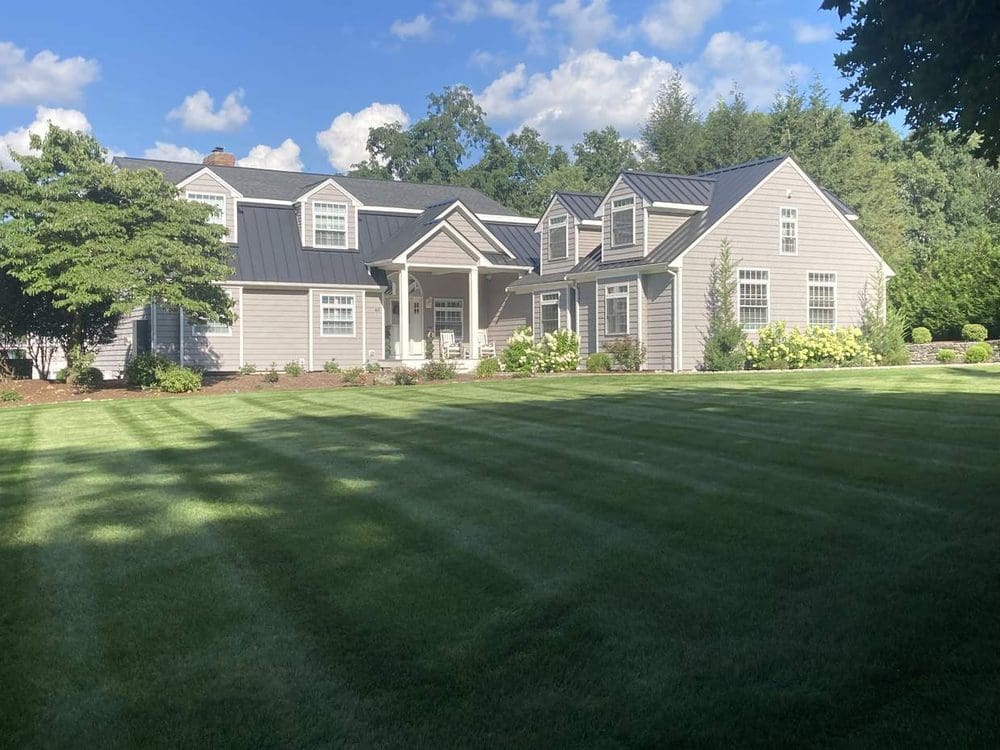
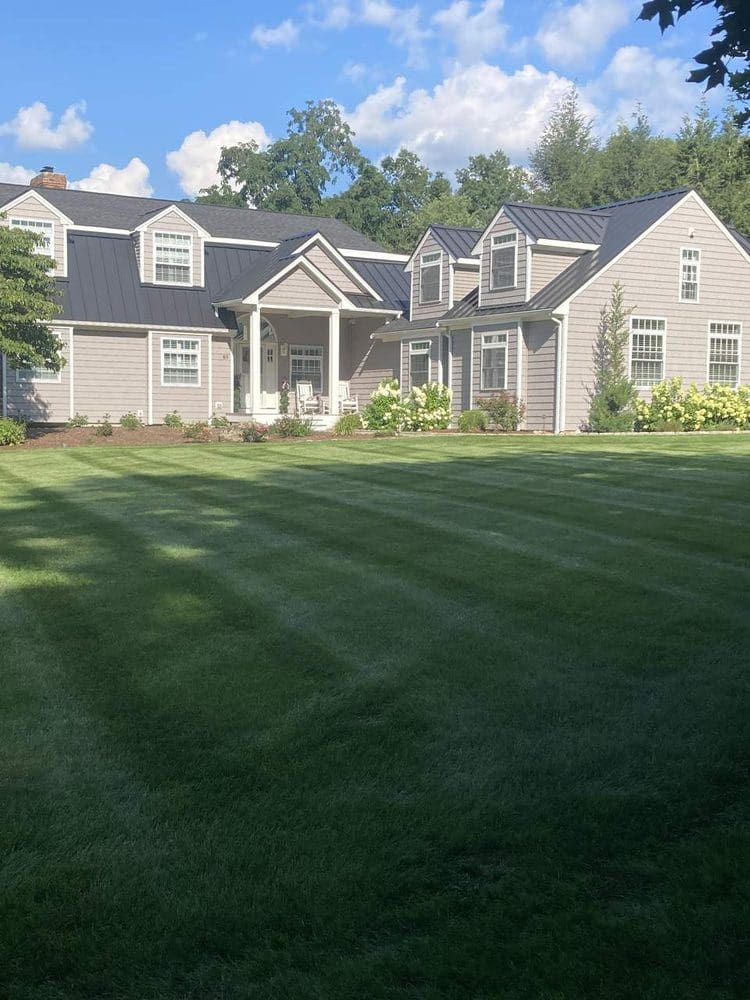
Mowing the same pattern every week trains grass to lean one way and compacts the soil under the wheel tracks. Alternate between north-south, east-west and diagonal passes. It also gives the striped look you see on well-kept lawns along Route 1A in Norfolk.
Mowing wet grass, drought and other tricky situations
Wet grass
Avoid it if you can. Wet grass clumps, clogs the deck, cuts unevenly and spreads fungal disease. Wet soil also compacts under the mower. If a rainy stretch leaves no choice, raise the deck a notch, slow down, and clean the deck afterward. Mowing at 4 p.m. after a morning rain usually works better than mowing at 8 a.m.
Summer drought
Cool-season grass slows or goes dormant when July temperatures hit the upper 80s and rain stops. A dormant lawn is tan but alive. Mow it less often, every 10 to 14 days, and only to remove seed heads and weeds. Raise the deck to 4 inches, and never mow in the heat of the afternoon. The UMass Extension turf program has good guidance on managing lawns through Massachusetts droughts.
Newly seeded or sodded lawns
Wait until new grass is 3.5 to 4 inches tall, usually three to four weeks after a September seeding. Mow on dry ground with a sharp blade at 3 inches. Sod can be mowed once it resists a gentle tug, about two to three weeks after installation.
Slopes and rocky spots
Plenty of Norfolk County yards sit on ledge or glacial till. Mow across a slope with a walk-behind, never up and down, and raise the deck over shallow rock so the blade does not strike. Bare, rocky strips along a retaining wall are often better mulched than mowed.
Edging and trimming: the finishing step
A lawn mowed at the right height still looks unfinished if the edges are ragged. Edge along walkways, driveways and beds every second or third mow with a stick edger or a string trimmer turned on its side. Trim around trees, fences and mailboxes every mow, but keep the trimmer head level so you do not scalp a ring around each post.
Keep a clean, deep bed edge around plantings. It stops grass from creeping into mulch, and it makes the mowing line obvious so nobody has to guess where the lawn ends.
Common mowing mistakes to avoid
- Cutting too short. The number one cause of thin, weedy lawns in Massachusetts. Stay at 3 inches or higher.
- Mowing on a fixed day no matter what. Follow the one-third rule, not the calendar.
- Running a dull blade all season. Brown tips and disease follow.
- Bagging every clipping. You are throwing away free nitrogen.
- Mowing wet April soil. Ruts and compaction last all year.
- Skipping the last mow. Long grass under snow gets matted and moldy.
- Same pattern every week. Wheel ruts and leaning grass.
What weekly lawn mowing costs in Norfolk County
Many homeowners eventually ask whether it is worth paying someone to handle this every week. Here are typical ranges for weekly mowing in the Wrentham, Franklin and Foxboro area. Prices vary by lot size, obstacles, slope and how much trimming and edging is included.
| Lot size | Per visit | Per season (28 visits) |
|---|---|---|
| Under 1/4 acre | $45–$65 | $1,260–$1,820 |
| 1/4 to 1/2 acre | $60–$90 | $1,680–$2,520 |
| 1/2 to 1 acre | $85–$130 | $2,380–$3,640 |
| Over 1 acre | $120 and up | $3,360 and up |
A standard visit includes mowing, string trimming, edging every other week and blowing off walks and driveways. Most companies in the area run a 26 to 30 visit season from late April through mid-November. Bi-weekly service usually costs 20 to 30 percent more per visit, because the grass is longer and takes more time. For comparison, a decent self-propelled mower runs $400 to $700, plus gas, blade sharpening and roughly 30 hours of your Saturdays each season.
When a full maintenance program makes sense
Weekly lawn mowing service on its own solves the time problem. A full property maintenance program solves the results problem. It bundles mowing with spring and fall clean-ups, fertilizer and weed control, aeration and overseeding, and mulch and bed care on one schedule.
A program makes the most sense when your lawn has stopped responding to mowing alone. If it thins out every August, if crabgrass takes over the edges, or if you are spending more on bagged fertilizer than the program would cost, bundle it. In Norfolk County, a full program for a half-acre lot typically runs $3,500 to $6,000 per season, depending on what is included. It also means one crew that knows your yard and adjusts how often to mow your lawn as the weather changes, instead of a fixed Tuesday whether the grass needs it or not.
Frequently asked questions
How often should you mow your lawn in the summer?
Every 7 to 10 days in a normal summer, and every 10 to 14 days during a drought when growth slows. Raise the deck to 3.5 or 4 inches from July through August.
Is it better to mow more often or let grass grow longer?
More often, with less taken off each time. When people ask how often to mow your lawn, that is the real answer. Frequent light cuts keep the plant healthy. Letting grass get long and then cutting it short is the most stressful thing you can do to it.
What height should I cut my grass in Massachusetts?
Three to 3.5 inches for most of the season, up to 4 inches in summer heat, and down to 2.5 inches for the first and last mow of the year.
Should I mow before or after fertilizing?
Mow first, then fertilize a day or two later. That way the granules reach the soil and you are not mowing for another five to seven days.
Can I mow every day?
You can, but it is pointless. Grass grows about a quarter inch a day at peak, so every 4 to 5 days in May is the most any Norfolk County lawn needs.
Get a free written estimate for weekly mowing
Whether you want weekly mowing or a full maintenance program, Ten Four Landscape & Construction serves Wrentham, Norfolk, Franklin, Foxboro, Plainville, Medway and Bellingham, and Seth is on every job. Call (508) 505-5416 or request a free written estimate online and we will put your yard on the schedule.