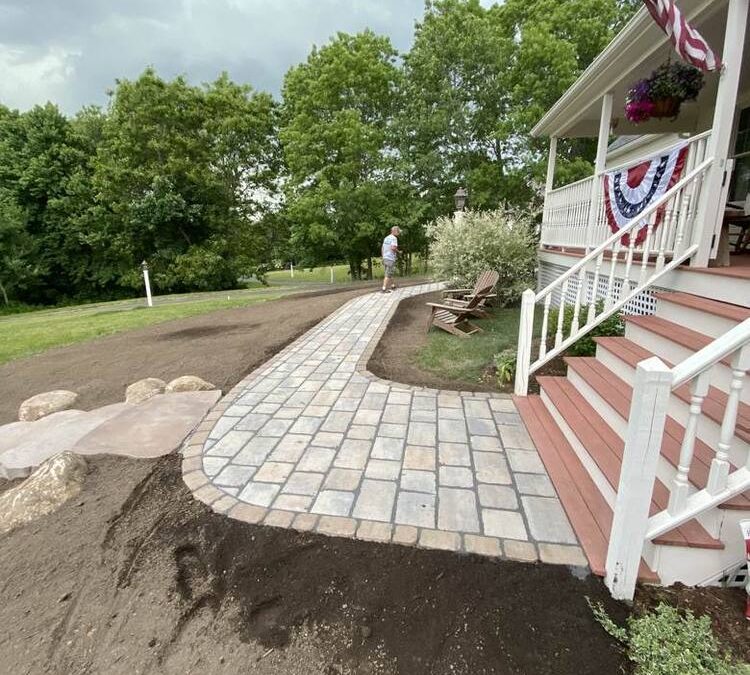
To answer how much mulch do you need, measure the bed in square feet, multiply by the depth in inches, and divide by 324. That gives you cubic yards. For example, a 300 square foot bed at 3 inches deep needs about 2.8 yards. Most beds in Wrentham and Norfolk County need a 2 to 3 inch layer, and you should top-dress with an inch or two every spring rather than strip and replace the whole bed each year.
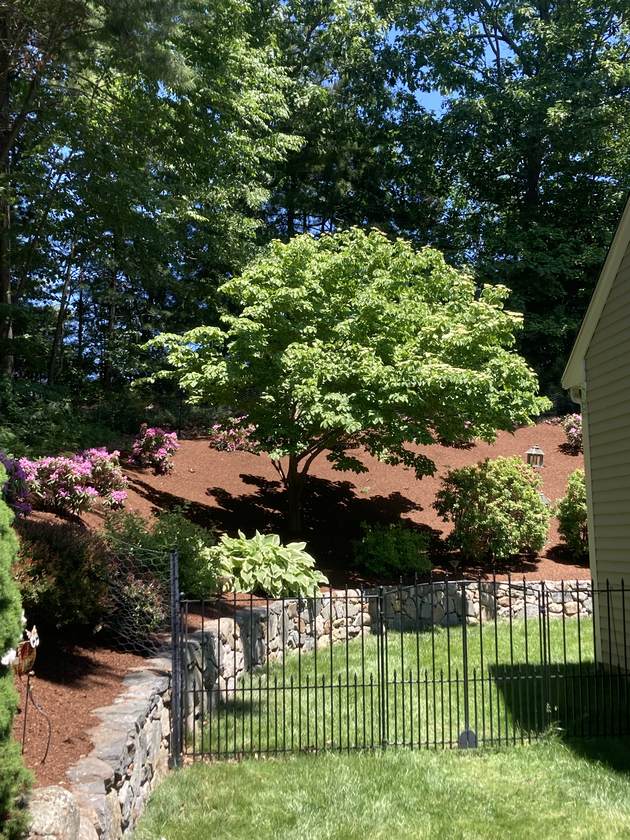
How much mulch do you need: the cubic-yard formula
Mulch is sold by the cubic yard, and one cubic yard covers 324 square feet at 1 inch deep. From there, the math is simple. Measure the length and width of each bed in feet and multiply them to get square feet. Then multiply by the depth you want in inches. Finally, divide by 324.
Square feet x depth in inches / 324 = cubic yards
Here is how that plays out for a few common bed sizes around Franklin and Foxboro. These assume a fresh 3 inch layer on bare soil.
| Bed size | Square feet | Yards at 2 inches | Yards at 3 inches |
|---|---|---|---|
| Small foundation bed (4 x 25 ft) | 100 | 0.6 | 0.9 |
| Front foundation bed (5 x 60 ft) | 300 | 1.9 | 2.8 |
| Island bed (15 x 20 ft) | 300 | 1.9 | 2.8 |
| Full front and side beds | 800 | 4.9 | 7.4 |
| Large property, all beds | 1,500 | 9.3 | 13.9 |
Round up to the next half yard, because beds are never perfect rectangles. In addition, mulch settles as it is spread and watered in, so a slight surplus keeps you from running short. If a bed is an odd shape, break it into rectangles and triangles, estimate each one, and add them together.
Measuring odd-shaped beds
For a curved bed, pace off the longest length and the average width, then multiply. For a circle around a tree, measure the radius in feet, square it, and multiply by 3.14. A 5 foot radius circle is about 79 square feet, which needs roughly 0.7 yards at 3 inches. Most homeowners get how much mulch do you need wrong, so measure twice before you order.
How deep should mulch be?
Depth is the second half of how much mulch do you need. The right depth is 2 to 3 inches for most beds. That is deep enough to block light from weed seeds, hold soil moisture through a dry July, and keep root zones cooler. Go thinner than 2 inches and weeds push through. Go thicker than 4 inches and water and air struggle to reach the soil, which stresses shrubs and invites fungus.
- Fine mulch (shredded hemlock, pine, double-ground bark): 2 to 3 inches. Fine material packs tighter, so it does not need to be as deep.
- Coarse mulch (bark nuggets, wood chips): 3 to 4 inches. Chunky pieces leave gaps, so a thicker layer is needed to block light.
- Around perennials and annuals: 1 to 2 inches. Deeper layers smother small plants and slow spring emergence.
- Top-dressing an existing bed: 1 to 1.5 inches, just enough to refresh color and cover thin spots.
Depth matters more in New England than in milder climates. Our soil freezes and thaws repeatedly from December through March, and that heaving can push shallow-rooted perennials out of the ground. A steady 3 inch mulch layer insulates the soil, so temperatures swing less and roots stay put.
Bags vs bulk: how much mulch do you need to buy?
Once you have answered how much mulch do you need, the next question is how to buy it. Bagged mulch comes in 2 cubic foot bags. There are 27 cubic feet in a yard, so it takes 13.5 bags to equal one cubic yard. Bulk mulch arrives loose in a dump truck or is loaded into your pickup at the supply yard.
| Bagged (2 cu. ft.) | Bulk (per yard) | |
|---|---|---|
| Price per yard | $55–$95 (13.5 bags at $4–$7) | $35–$65 picked up |
| Delivery | Fits in a car trunk | $50–$100 per load, often free over 5 yards |
| Best for | Under 2 yards, touch-ups | 3 yards and up |
| Downside | Plastic waste, hauling 40 bags | Pile on the driveway until spread |
The break-even point sits around 2 to 3 yards. Below that, bags are convenient and you can buy a few at a time. Above that, bulk saves money and time, because you are not loading and lifting 40 bags of wet mulch. Most Wrentham homes with a full set of foundation beds need 4 to 8 yards, so bulk is usually the better call.
Mulch types common in Norfolk County
The mulch you choose changes both the look and the price. Around here, four types cover nearly every job, and all are sold by the yard.
Hemlock mulch
Hemlock is the classic New England bark mulch. It holds a rich reddish-brown color longer than most natural mulches. Because true hemlock is harder to source, many yards sell a hemlock blend. Expect $45 to $65 per yard for material and $85 to $130 per yard installed.
Pine and dark pine bark
Pine bark mulch is finer, breaks down a bit faster and feeds the soil as it does. It starts brown and fades to gray over a season. It is the most budget-friendly natural option, at roughly $35 to $50 per yard for material.
Black-dyed mulch
Black-dyed mulch is ground recycled wood colored with carbon-based dye. It gives beds a sharp, modern look and holds color well through the summer. However, it adds little to the soil, and the dye can stain a new patio or walkway if it is spread carelessly. Material runs $40 to $60 per yard.
Cedar mulch
Cedar lasts the longest and resists insects. It also costs the most, often $60 to $85 per yard, and its light color fades to silver. Cedar is a smart choice near a deck or foundation where you want the slowest breakdown.
Should you replace mulch every year?
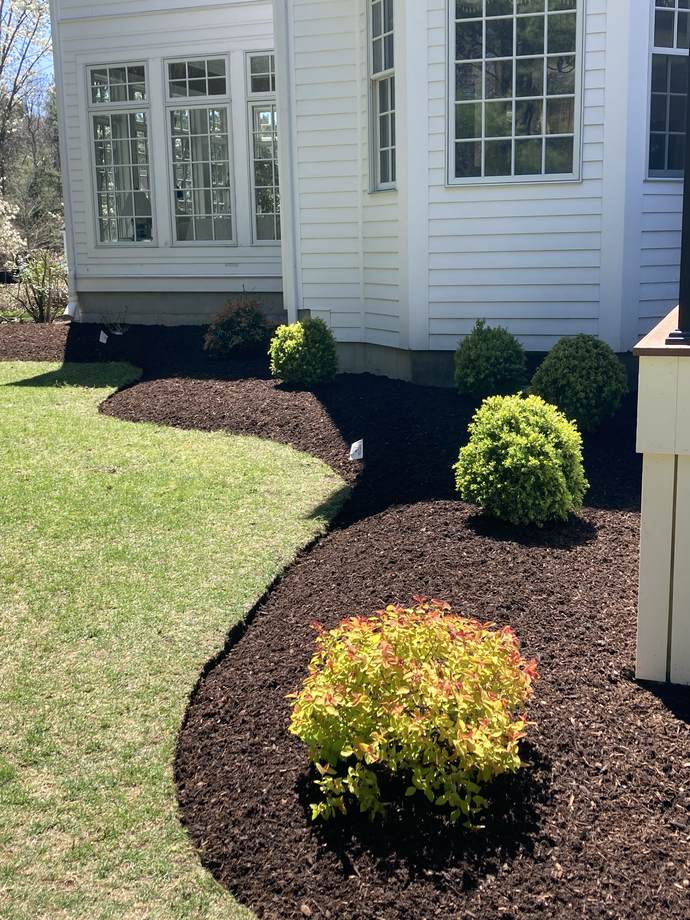
No. In most beds, you should top-dress every spring and fully replace only every three to five years. Natural bark mulch breaks down into the soil, which is a good thing. It adds organic matter to the heavy clay and rocky fill under most yards from Plainville to Medway. Stripping it out every year throws that benefit away and doubles your cost.
Annual top-dressing
Each spring, rake the old mulch to break up any crust, pull weeds, and spread 1 to 1.5 inches of fresh material on top. This refreshes the color and brings the total depth back to 3 inches. A top-dress uses about half the mulch of a full install, so a bed that took 6 yards new needs only 3 yards to refresh.
When a full replacement makes sense
Replace everything when the old mulch has compacted into a mat that sheds water, when it has built up past 4 inches from years of adding, or when it is full of fungus, artillery mold or weed seed. Dyed mulch also tends to need full replacement more often, because it fades without breaking down. In short, check the depth before you order. If a screwdriver sinks 5 inches into old mulch, remove some before adding more.
Mistakes to avoid: skipping the edge and mulch volcanoes
Edge the beds first
Fresh mulch on a bed without a clean edge looks unfinished within a month. Edging cuts a 3 to 4 inch trench between lawn and bed, so mulch stays put and grass stops creeping in. It also gives the bed a defined shape, which is most of what people notice from the street.
- Mark the bed line with a garden hose or marking paint.
- Cut a vertical edge 3 to 4 inches deep with a flat spade or a bed edger.
- Remove the sod strip and any grass roots that have crept into the bed.
- Pull weeds and rake the old mulch level.
- Then spread the new mulch, keeping it an inch below the lawn edge so it does not spill.
Edging is included in most professional mulch and edging quotes, and it is the step most DIY jobs skip. Doing it first also gives you an exact measurement, so you know exactly how much mulch you need before the truck shows up.
Never build a mulch volcano
Piling mulch against a tree trunk is the most common mulching mistake in Norfolk County. Those cone-shaped mounds, called mulch volcanoes, hold moisture against the bark. As a result, the bark rots, insects move in, and roots grow up into the mulch instead of down into the soil. Trees in newer Franklin and Bellingham subdivisions often show girdling roots from years of volcano mulching.
Instead, spread mulch in a flat donut. Keep it 3 to 6 inches away from the trunk so the root flare stays exposed. Extend the ring out to the drip line if you can, at 2 to 3 inches deep. The same rule applies to shrubs, because mulch packed against the base of a rhododendron or boxwood causes the same rot. For more on tree health, the UMass Extension landscape program publishes guidance written for Massachusetts conditions.
When to mulch in Massachusetts
The best window for spring mulching in the Wrentham area is late April through May. By then, the soil has warmed, spring bulbs are up, and the last frost date has passed or is close. Mulching in March traps cold in the soil and slows perennials. Mulching in June means fighting weeds that have already germinated.
Fall is the second good window. A fresh layer in October or November after clean-up insulates roots through the freeze and thaw cycle and looks tidy all winter. Meanwhile, avoid mulching in mid-summer drought, because dry mulch on dry soil does little. Many homeowners bundle mulching with their spring and fall clean-up so the beds are edged, weeded and mulched in one visit.
Mulch cost per yard installed in the Wrentham area
Installed mulch pricing around Wrentham, Norfolk and Foxboro typically runs $85 to $130 per cubic yard, including delivery, edging, spreading and clean-up. Material accounts for about $40 to $65 of that, and labor covers the rest. These are typical ranges for the area, and the final number depends on the material, bed access and how much prep the beds need.
| Job size | Yards | Typical installed cost |
|---|---|---|
| Small foundation beds | 2–3 | $250–$400 |
| Full front and side beds | 5–7 | $450–$850 |
| Large property, all beds | 10–15 | $900–$1,800 |
Prices go up when beds are far from the driveway, on a slope, or behind a fence, because every yard has to be wheelbarrowed by hand. They also go up when old mulch has to be removed and hauled away, usually $30 to $50 per yard extra. Prices come down when the beds are already edged and weeded, or when mulching is part of a larger property maintenance plan.
DIY mulching vs hiring a pro
Spreading mulch is one of the more DIY-friendly landscape tasks. If you know how much mulch you need, have 3 yards or less, and own a wheelbarrow and a bow rake, you can do it in a Saturday. The material alone will cost $150 to $250, plus delivery.
The math changes above 5 yards. A crew with a dump trailer and three people spreads 10 yards in a few hours, edges every bed and leaves the driveway clean. Doing the same job alone takes a full weekend. Hiring also makes sense when the beds need new plantings, a fresh edge or drainage fixes at the same time, since one crew can handle the planting and the mulch together.
Frequently asked questions
How many bags of mulch equal one cubic yard?
It takes 13.5 bags of 2 cubic foot mulch, or 9 bags of 3 cubic foot mulch, to make one cubic yard. So a 3 yard job means roughly 40 standard bags.
How much mulch do you need for a 10 x 10 bed?
A 10 by 10 foot bed is 100 square feet. At 3 inches deep, that is 100 x 3 / 324, or about 0.9 cubic yards. Order one full yard and you will have a little left for touch-ups.
Does mulch attract termites?
Mulch itself does not attract termites, but a thick layer piled against a foundation gives them cover. Keep mulch 6 inches below siding and pull it back from the foundation a few inches.
Can I put new mulch over old mulch?
Yes, if the old layer is under 2 inches and not compacted. Rake it loose first, then add 1 to 1.5 inches on top. If the total would exceed 4 inches, remove some old material first.
Is dyed mulch safe for plants and pets?
Black and brown dyed mulches use carbon or iron oxide dye, which is safe. The concern is the wood source, so buy from a supply yard that uses clean, untreated wood instead of shredded pallets.
Get a free written estimate for mulch and edging
Still asking how much mulch do you need, or which type fits your beds? Ten Four Landscape & Construction edges, weeds and mulches beds across Wrentham, Norfolk, Franklin, Foxboro, Plainville, Medway and Bellingham, and Seth measures every bed himself. Call (508) 505-5416 or request a free written estimate online and we will put the yardage and price in writing.